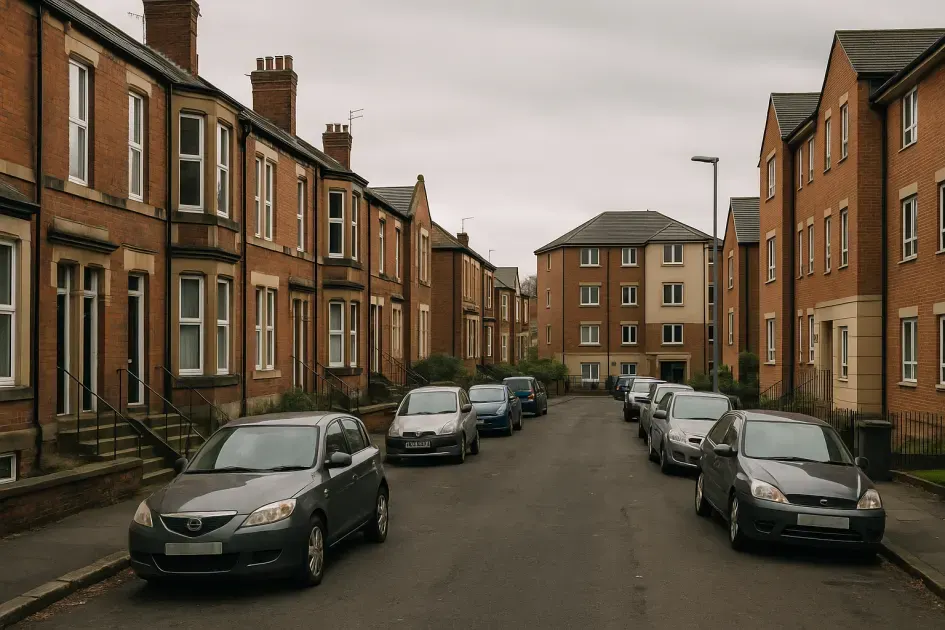
Jesmond property challenges are tied to the local building mix. Housing style affects how easily furniture leaves the property, how predictable access is, and whether the crew is working through clean internal routes or wrestling a sofa through awkward building layouts and tight access points.
Jesmond tends to be shaped by late Victorian and Edwardian terraced houses subdivided into student and sharer flats, large period semi-detached houses converted into multi-storey apartments and purpose-built apartment blocks with managed entrances and rear car parks. For property challenges, that matters because that local housing mix often brings permit-controlled residential streets with short kerb frontage outside converted houses and stair access, which can turn an ordinary-looking address into a slower route with tighter corners, stair friction or awkward furniture angles.
This part of Newcastle creates its own loading rhythm. In Jesmond, practical factors like resident permit bays, pay-and-display controls limit van stopping time on many streets and side-street loading and weekday commuter pressure and evening congestion increases around acorn road, osborne road when kerb turnover is high shape how the day actually unfolds.
That matters whether you are arranging a studio move, a flat relocation or a larger household shift with vetted and approved drivers available through the platform. Clear planning protects time, and time is what usually protects the budget.
A straightforward job in Jesmond can still slow down when building access is sequential rather than parallel. One person may be waiting at an entry point while another handles the van, or the team may need to coordinate around lift use, side-street loading or a longer internal walk from courtyard to entrance. Those are ordinary local realities, not unusual complications.
That is why this page works best as part of a clear planning path. The moving guide is the main hub for this area. For one closely related angle, see Moving Costs. For a second supporting issue, review Parking Permits. For broader regional context, see the Newcastle macro guide. When you are ready to connect local planning back to the full service page, return to the Jesmond man and van page. For comparison with other cities, see our national moving guides.
Use this page as a planning layer, then use the Jesmond man and van page when you want to request the actual service. Support pages should clarify planning factors rather than duplicate the booking page. That way lies cannibalisation and other structural issues.
Common questions about building access and property layout in Jesmond.
Yes. Stairs and split routes affect every repeated trip, so they change the pace of the whole move rather than creating just one awkward moment.
Because they can introduce waiting points, access control and route narrowing. They are manageable, but they need to be planned for honestly.
In Jesmond, the hardest properties are usually the ones where the route is indirect rather than simply large. Property types such as late Victorian and Edwardian terraced houses subdivided into student and sharer flats and large period semi-detached houses converted into multi-storey apartments can all create friction in different ways depending on how the access path behaves.
Very often. A converted building may look straightforward outside while hiding tighter stairs, less predictable lift access or longer internal routes once the job starts.
Measure doorway widths, stair turns, lift dimensions where relevant, and the real path from the furthest loaded room to the van position.
Yes. Lofts, garages and secondary storage areas spread the inventory across more space, which lengthens the loading phase even when the property looks manageable from the front door.