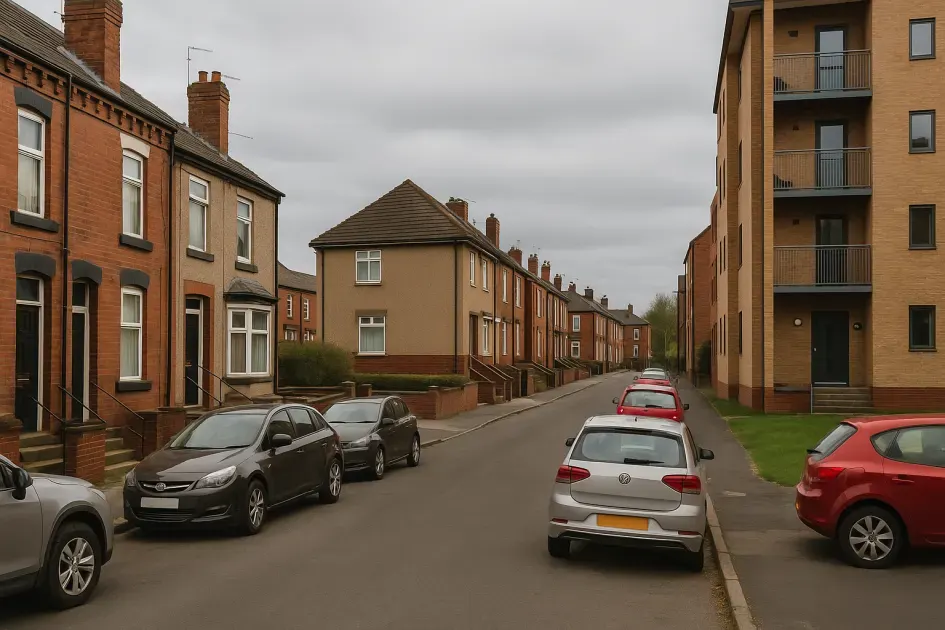
South Leeds is a patchwork of dense Victorian terraces, inter-war semi-detached suburbs, post-war estates and pockets of recent new-build housing. That mix means each move here brings a distinct set of physical challenges that affect how long a removal takes, what equipment is sensible to bring and whether extra permissions or pre-planning are needed.
Areas such as Beeston and Holbeck feature long runs of terraces with small front yards, narrow porches and internal staircases built for day-to-day domestic life rather than large furniture. Operational friction includes restricted manoeuvre space for sofas, tight internal doorways that may require partial disassembly, and limited or no kerbside parking immediately outside. In practice this increases carry distance and handling time — a two-up, two-down terrace move can easily add 30–60 minutes per large item compared with properties with wider access.
South Leeds removals service is the main booking page for checking availability, pricing and move details in one place, while access and property guide for Leeds gives broader regional context on property and access conditions.
South Leeds contains both purpose-built blocks with freight-sized lifts and numerous converted flats above shops or houses. Converted flats (common near commercial strips and older terraces) often have steep, narrow staircases and small landings that slow every trip. Purpose-built blocks may offer lifts but with limits: lift size, management-company rules, morning delivery windows or service lifts that must be booked. These constraints translate into longer loading times, potential slot-booking requirements, and sometimes the need for smaller vehicles or more crew to shuttle items in stages.
Many residential streets off Dewsbury Road and around Hunslet are narrow and were not designed for modern large vans. Resident permit zones, single-yellow lines that prohibit daytime loading, and short front gardens mean removal vehicles cannot always park close to a front door. Practical consequences are longer carry distances across pavements or communal areas, the potential need to apply for temporary parking suspensions from the council, and additional time allowance for parking searches on moving day. Each added minute of carry and search time increases labour costs and the overall length of the job.
Access issues usually sit alongside other planning points, so compare this page with moving guide for South Leeds and hidden moving costs in South Leeds.
Suburban parts of South Leeds, including semi-detached estates near Middleton and Belle Isle, generally give better kerbside access and driveways but often come with larger, heavier furniture and longer staircases inside. Dense inner areas provide shorter street-to-door distances but tighter exterior space and more parking controls. That means planning must be tailored: suburban moves may need vehicle access for long-duration loading, while dense-area moves focus on handling logistics and legal parking solutions.
Recent developments on the southern edges introduce modern lift access and straight staircases, which can speed internal handling. However, new estates often prioritise landscaped frontages and pedestrian-friendly shared surfaces that restrict vehicle proximity. Some estates have narrow service roads unsuitable for large removal trucks, or gated access that requires advance coordination with developers or management companies. Expect time spent arranging vehicle approach routes and possibly using smaller tail-lift vehicles or multiple short carries across walkways.
Every element above turns into measurable operational friction: more carries per item, longer loading windows, additional crew hours, and potential permit or suspension fees. For example, a terrace-to-flat move where the receiving property has a small lift may need two extra crew members and an additional hour of loading — both of which increase labour costs. Similarly, if parking suspensions or loading bans require council applications, those steps must be factored into the schedule to avoid last-minute delays.
For an overview of typical South Leeds layouts and options specific to this area, see the South Leeds removals page at South Leeds removals service. For guidance on measuring access and documenting constraints, consult the city-wide resource at access and property guide for Leeds. For a checklist tailored to moving day in South Leeds, you can also review the local moving guide at moving guide for South Leeds.
Practical answers to common access and property problems encountered during removals across South Leeds neighbourhoods such as Beeston, Holbeck, Hunslet, Belle Isle and Middleton.
Victorian and early-20th-century terraces common in Beeston and Holbeck typically have narrow hallways, tight internal doors and steep staircases. These features increase carry time per item, reduce safe carrying speeds, and can require more handlers or specialist equipment (e.g. stair-climbing dollies). That extra labour and slower loading/unloading directly increases overall move time and therefore cost.
South Leeds has a mix of purpose-built blocks with lifts and many converted flats above shops or in older houses. Converted flats often have narrow, shared stairwells, small landings and no lift access, which can add significant carry distance and increase the risk of damage. Purpose-built blocks may have lifts but sometimes with restricted access times or size limits: this affects scheduling and may require booking lift use with the managing agent in advance.
Yes. Many residential pockets—particularly near Hunslet and central Beeston—have resident permit schemes, single-yellow lines, or driveways that are too shallow for a large removal vehicle. Removals teams frequently need to allow time for finding legal parking, walking longer carry distances, or obtaining a temporary loading bay/parking suspension from the council. These steps add planning time and potential permit fees.
Not always. New-build estates around the South Leeds fringe can have modern lifts and wider doors, but they also feature landscaped communal areas, narrow access roads, and restrictions on parking close to front doors. Conversely, older semi-detached or inter-war houses may allow direct street access but still present awkward interior layouts. Each property type shifts the friction from internal handling to external access or vice versa.
Identify the property type early (terrace, converted flat, purpose-built flat, semi or new build) and record details: presence and size of lifts, number of stairs, distance from kerb to front door, and local parking controls. Use that information to plan vehicle size, crew numbers and to book any necessary parking suspensions or lift bookings. Resources such as the South Leeds removals overview and the city access guide can help outline required checks in advance: /removals/leeds/south-leeds and /removals/leeds/access-and-property-guide.
Yes. Lofts, garages and secondary storage areas spread the inventory across more space, which lengthens the loading phase even when the property looks manageable from the front door.