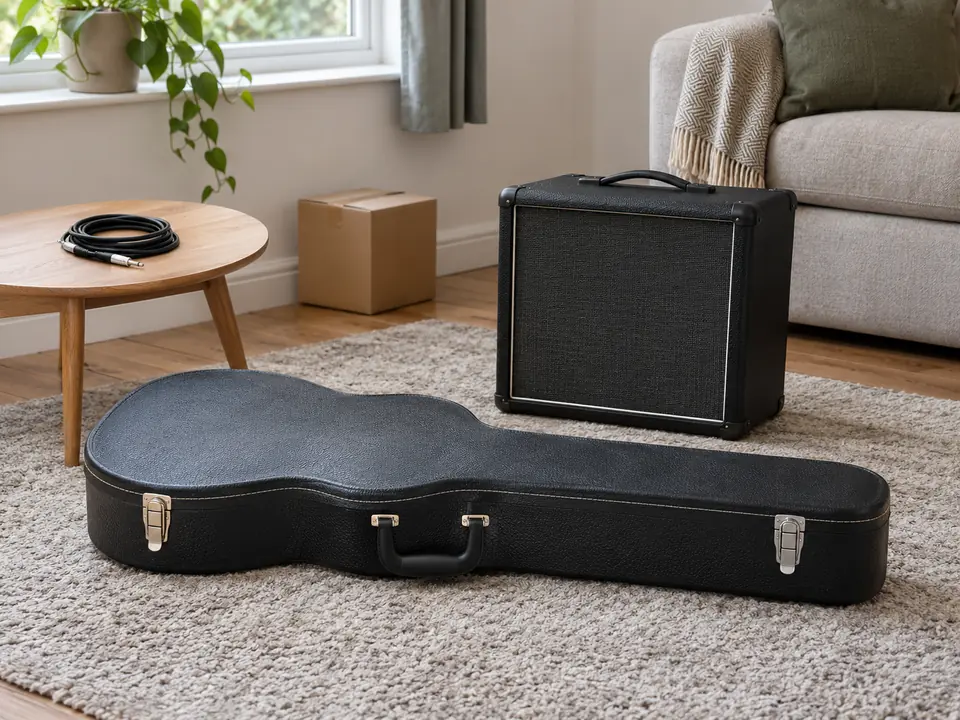
“One guitar and an amp” can mean a cased acoustic and a compact practice amplifier, or several instruments, a separate amplifier head, speaker cabinets and a pedalboard. Start with the actual equipment, then agree its preparation and transport rather than treating it as an unspecified box of music gear.
This guide covers planning a UK household move or small collection involving guitars and amplifiers. It does not provide instrument repairs, amplifier servicing, touring freight or a promise of specialist musical-instrument transport. Particularly valuable, fragile or unusual equipment needs an explicit acceptance and handling discussion before booking.
List the instrument, case and accessories separately
Record the make and model of each guitar, whether it is acoustic or electric, and any known condition concerns. Photograph its visible condition for your own record. If its construction, repair history or value makes preparation uncertain, ask the maker or a suitable instrument technician for advice.
Add the case as part of the description: fitted hard case, gig bag or another arrangement. A guitar’s dimensions alone do not describe the packed item that must fit through the carrying route and into the load.
Give the amplifier its own entry, including the model and whether it is a combo, head or separate cabinet. Add pedalboards, foot controllers, stands, leads and power supplies to the inventory. State which accessories travel in separate containers and which, if any, you are taking yourself.
Resolve the case before collection day
Inspect the case and its closures and establish whether it is suitable for the instrument and planned journey. If the case is missing, damaged or a poor fit, arrange appropriate advice and replacement protection before confirming that the item is ready. Do not add loose packing material against an instrument’s finish without checking its suitability.
Fender’s guitar-care guidance identifies a hard case as a strong protective option and warns about abrupt temperature and humidity changes. It supports planning protection and environmental care; it does not establish that every case or van journey is suitable for every guitar.
Ask the manufacturer or technician about preparation for your particular instrument, including any question about strings or vulnerable fittings. There is no universal instruction here to loosen strings, remove parts or adjust the neck. Keep technical work with someone competent to assess the instrument.
Prepare amplifiers using their own instructions
Locate the correct manual and identify who will complete shutdown, disconnection and any required preparation. An amplifier can have connections to a cabinet, pedalboard and other equipment; photograph the arrangement if useful before it is taken apart.
The BOSS KATANA safety guide instructs users to disconnect the power plug and external cords before moving the unit. Its warnings also prohibit removing the speaker grille and speaker on the listed models. These are model-family instructions, not permission to open or service another amplifier.
A separate cabinet may have its own handling requirements. The BOSS KTN-CAB212 manual, for example, specifies at least two people for lifting and moving that cabinet. Share the applicable manual with the mover rather than assuming one person can carry an item because it has a handle.
For valve equipment, unfamiliar modifications, damage or missing instructions, obtain appropriate manufacturer or technician advice before packing. Do not remove valves, panels or internal parts as a generic moving precaution. A collection team should receive prepared equipment, not an unresolved servicing job.
Keep cables and small parts identifiable
Match detachable power supplies, foot controllers and leads to the relevant equipment. Use labels on their packaging or a separate inventory so similar-looking items do not become an unexplained cable bundle at delivery.
Arrange suitable protection for pedalboards and other accessories, including controls and projecting connectors. Ask whether any detachable components need a separate container and record that container in the load count. Do not leave accessories loose inside a guitar case unless its instructions and the instrument’s protection allow for them.
Keep setup photographs and model instructions available to the person reconnecting the equipment. They need not travel as the only copy inside a carton that will be unloaded last.
Describe the packed load and the whole route
Give the booking team the number and dimensions of the prepared cases and containers, plus reliable weight information where available. Say when a weight is unknown. Include stairs, lifts, narrow turns and the distance from a lawful loading position at both ends.
Explain the actual collection setting. A storage room, upstairs flat and rehearsal space may each need a different contact, access appointment or route assessment. Obtain permission from the person responsible for the building where required, and identify who can admit the collecting team.
Agree who supplies and completes protection, who carries the items and whether a specialist assessment is needed. Declare value and ask about applicable cover, exclusions and reporting arrangements. A fragile label, case or general insurance statement is not a complete handling agreement.
Prepare a receiving room and a clear handover
Have an authorised receiver and suitable destination space ready. Discuss environmental concerns with the maker or technician, especially if the instrument will move between very different conditions. Do not leave its storage decision until the van arrives or assume household transport is climate controlled.
Check the cases, amplifier and accessory containers against the agreed record at delivery. Record visible concerns through the agreed process, retain useful packaging and follow model-specific advice before opening, reconnecting or using the equipment. Arrange technical assessment if something appears wrong rather than testing an uncertain electrical item.
For an acoustic piano, use the separate piano-move planning guide; its assessment is a different task. Records have their own vinyl-collection preparation checklist. For a limited household load, describe the complete prepared equipment in a small-move enquiry and obtain confirmation of suitability before booking.

Liz
Liz is a content creator and digital marketing consultant. Originally from Toronto, Ontario, Canada, she is now happily settled in the UK (after living in four different countries across 2 continents and moving house 10 times). Drawing on her experiences, Liz shares practical advice and insider tips to help others enjoy smoother, stress-free moves.

The Packing Guides at Find My Man and Van focus on helping you protect your belongings and pack efficiently for any type of move. From fragile items and bulky furniture to room-by-room packing strategies, our guides share proven techniques used by professional movers. With clear instructions and practical tips, we help you save time, reduce damage risk, and stay fully prepared for moving day.