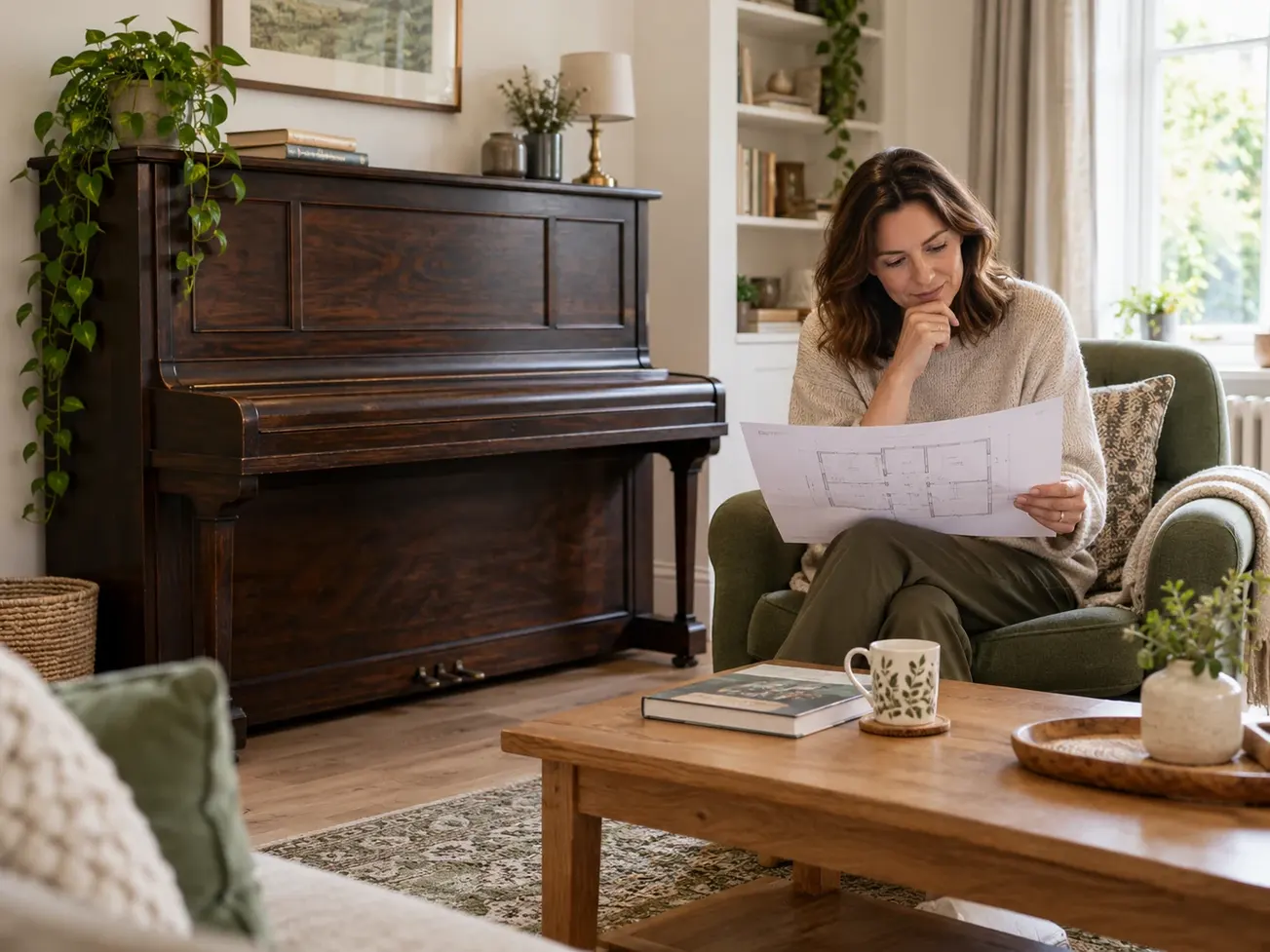
An acoustic piano needs its own moving plan. Its size is only part of the picture: stairs, turns, the instrument’s condition and the route into its new room all affect what needs to be assessed before a booking can be confirmed.
Start by finding a mover who can assess the particular piano and both addresses. Do not assume that a household furniture booking includes piano handling, or that a piano on castors can simply be rolled through the move.
Identify the instrument
Tell the prospective mover whether the piano is an upright or a grand. Include the maker and model if known, photographs of the complete instrument and any dimensions the mover requests. A digital keyboard, digital upright and acoustic upright are different items; describing all three as a piano can leave important details unclear.
If the weight is unknown, say so. Do not substitute a guessed figure from a similar-looking instrument. A maker’s model information may help, but let the specialist determine what further assessment is needed.
Mention existing damage, loose parts or previous repairs that you know about. Photograph the condition before the move and agree how any concerns will be recorded. These records support a clear handover; they do not establish what the mover’s cover includes.
Keep the stool, music and other accessories on the inventory too. Confirm whether they travel with the piano and how they should be prepared.
Show the whole access route
The assessment needs to cover the journey from the piano’s current position to the vehicle and from the vehicle to its intended position at the destination. A photograph of the front door alone cannot show the whole route.
Provide clear photographs or a video requested by the mover, including:
- Steps, flights of stairs and landings at either address.
- Narrow doorways, corridors and tight turns.
- Shared entrances, thresholds and changes in floor level.
- The distance between a lawful loading position and the building.
- Any lift that forms part of the proposed route, with the building’s restrictions.
Ask which measurements the assessor needs. Do not assume that fitting through one doorway proves the piano can negotiate the turn immediately after it. Building access permission and a mover’s handling assessment are separate requirements; both need to be settled.
If there is no straightforward route, stop planning the move around an assumed solution. External lifting, alterations or unusual access arrangements require appropriate specialist assessment and any relevant permission. The household should not improvise equipment or a lifting method on moving day.
Agree specialist handling before confirming the date
A Steinway dealer’s piano service guidance advises using a professional piano mover for stairs and moves between homes. It is useful support for arranging professional assessment, not evidence that a particular UK booking includes this work.
Ask the prospective mover to confirm the agreed instrument, addresses, access and handling scope in writing. Discuss who will carry out the move, what preparation they require and whether a survey is needed before the price and booking are finalised.
Clarify the arrangements for damage reporting and the cover that applies to the instrument. Give accurate information about its value when requested, and ask about any exclusions or separate arrangements relevant to your piano. Avoid treating a general statement about insurance as a complete answer.
Our heavy furniture guide covers the importance of declaring unusual loads. If you enquire through Find My Man and Van, declare the piano before booking and obtain explicit confirmation that its requirements can be met. A standard furniture booking does not establish that specialist piano handling is available.
Prepare the destination room
Choose a proposed position before the assessment so the mover can consider the full delivery route. Ask a piano technician about the suitability of the location if temperature, humidity or floor conditions are uncertain.
Yamaha’s piano maintenance guidance explains that environmental conditions matter to an acoustic piano and advises against placing it near heating or air-conditioning vents. Follow advice appropriate to the instrument rather than choosing a spot solely because there is a convenient gap.
Keep the agreed route clear of boxes and other furniture. Arrange access keys and any building contact in advance. If the piano delivery forms part of a larger move, agree the sequence with everyone involved so another load does not obstruct its route.
For a city property, the city-moving guide helps you coordinate parking and building access. Those arrangements support the move but do not replace the piano assessment.
Plan the handover and aftercare
Be available, or appoint an informed adult, to confirm the agreed destination and review the instrument after delivery. Record concerns promptly using the mover’s reporting procedure. Do not try to reposition the piano yourself once the specialist has left; ask for advice if the planned location needs to change.
Ask a piano technician when the instrument should be checked or tuned after arrival. There is no fixed waiting period offered here: the instrument, journey and conditions at the new home should inform that advice. Tuning and internal adjustments belong with an appropriately qualified professional.
If the piano will spend time in storage between homes, arrange that explicitly with the specialist. A household storage booking does not by itself confirm suitable handling or environmental conditions for an acoustic instrument.
The useful outcome of this planning is a confirmed scope: the right instrument, an assessed route at each address, an agreed delivery position and clear responsibility for the move.

Liz
Liz is a content creator and digital marketing consultant. Originally from Toronto, Ontario, Canada, she is now happily settled in the UK (after living in four different countries across 2 continents and moving house 10 times). Drawing on her experiences, Liz shares practical advice and insider tips to help others enjoy smoother, stress-free moves.

Our Moving House Guides support homeowners and renters through every stage of relocating to a new property. At Find My Man and Van, we provide step-by-step advice on planning timelines, organising utilities, preparing furniture, and coordinating your move day efficiently. Whether you’re moving locally or further afield, these guides are created to help make your house move smoother, more organised, and less stressful.