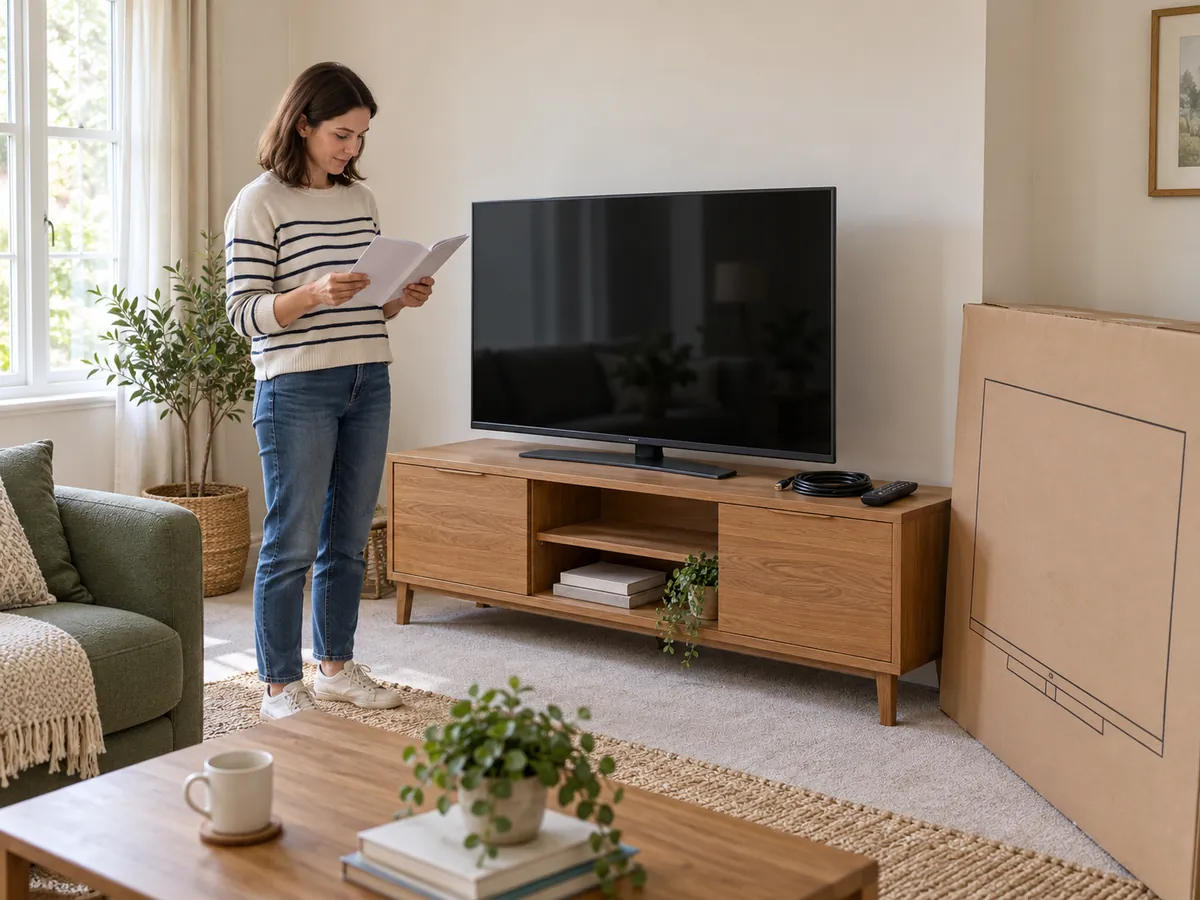
Give a television its own entry in the moving inventory. The screen size alone does not explain the packed dimensions, how the set is mounted or what must be ready before it can leave the room.
Start with the exact model and its instructions, then agree the packaging and carrying arrangements. A cover that looks protective is not a complete transport plan, particularly when the original packaging is missing.
Find the instructions for your actual television
Locate the model number and the manufacturer's handling and installation information. Keep the relevant instructions accessible with your move records. Different sets can have different stands, mounting systems and handling requirements; a technique remembered from an older television is not a substitute.
LG's relocation guidance highlights checking the product and box dimensions, measuring the route and avoiding pressure on the screen. It also says not to move a large TV alone. These are useful planning points, but the instructions for your own model remain the reference for the people doing the work.
If you cannot establish the correct preparation, resolve that with the manufacturer or appropriate installer before collection. Do not turn uncertainty about a stand or bracket into a last-minute experiment.
Agree what packaging will be used
Check whether you still have the correct carton and its fitted components, and whether they are complete and in usable condition. An empty carton that happens to fit around the television is not automatically equivalent to the original packaging system.
If the original materials are unavailable, tell the mover early and agree who will supply suitable protection. Describe the television accurately and ask how the proposed packaging accommodates it. Do not assume a standard moving blanket, a generic box or a fragile label solves every screen-protection issue.
Keep adhesives and makeshift restraints away from the screen unless the model's instructions specifically require them. Confirm the intended transport arrangement with the people handling the load rather than deciding it solely from the space left in a vehicle.
Separate wall removal from collection
Record whether the television is on a stand or wall-mounted. Establish who will remove it, what fixings need to be retained and whether that work is included in any separately agreed service.
If an installer is needed, coordinate their visit with the collection time. Ask about the wall bracket and the destination installation as separate tasks. A booking to transport the television does not by itself confirm that a wall installation will be taken down or rebuilt.
Keep the correct screws and stand components identified for this particular set. Use a labelled container in your own parts record; do not rely on an unmarked handful of fixings arriving somewhere among the boxes.
Record cables and accessories before packing
Photograph the connection arrangement if that will help you reconstruct it. Keep the remote, relevant cables and any separately packed devices together in a clearly recorded group. Photograph only what you need; avoid including account details or personal information visible on a screen.
Follow the manufacturer's preparation instructions and let the agreed person handle any work outside your competence. Do not pull cables or move the set merely to hurry the inventory check.
A short record helps everyone understand what is being collected:
| Item | What to confirm |
|---|---|
| Television | Model, dimensions and current mounting arrangement |
| Packaging | What is available and who supplies anything missing |
| Accessories | Which cables, remote and parts travel with the set |
| Access | Doors, turns, stairs, lifts and the destination room |
These are planning headings, not a packing specification or a guarantee against damage.
Measure the packed route and receiving space
Use the packed dimensions for access planning. Check doorways, turns, stairs and lifts at both addresses, and tell the mover about restrictions before the day. A television that fits on a wall does not necessarily fit through the route in its carton.
Prepare an agreed place for it to wait at arrival, away from the active unloading route. Confirm any stand assembly or mounting arrangements before expecting it to be installed as soon as it reaches the room.
If conditions or access change, update the plan. Do not force a package through a gap or remove protection simply to make an unverified route work.
Check the set and finish the record
Follow the relevant unpacking and setup instructions after arrival. Keep the packaging until you have checked the contents and any concerns, using the mover's agreed reporting process where appropriate. Do not treat a label or a photograph as a substitute for checking the actual item.
Use our general packing guide for the rest of the household and the box-selection guide for ordinary cartons. For a television travelling on its own, describe the packaging, access and loading help in a single-item transport booking.

Liz
Liz is a content creator and digital marketing consultant. Originally from Toronto, Ontario, Canada, she is now happily settled in the UK (after living in four different countries across 2 continents and moving house 10 times). Drawing on her experiences, Liz shares practical advice and insider tips to help others enjoy smoother, stress-free moves.

The Packing Guides at Find My Man and Van focus on helping you protect your belongings and pack efficiently for any type of move. From fragile items and bulky furniture to room-by-room packing strategies, our guides share proven techniques used by professional movers. With clear instructions and practical tips, we help you save time, reduce damage risk, and stay fully prepared for moving day.