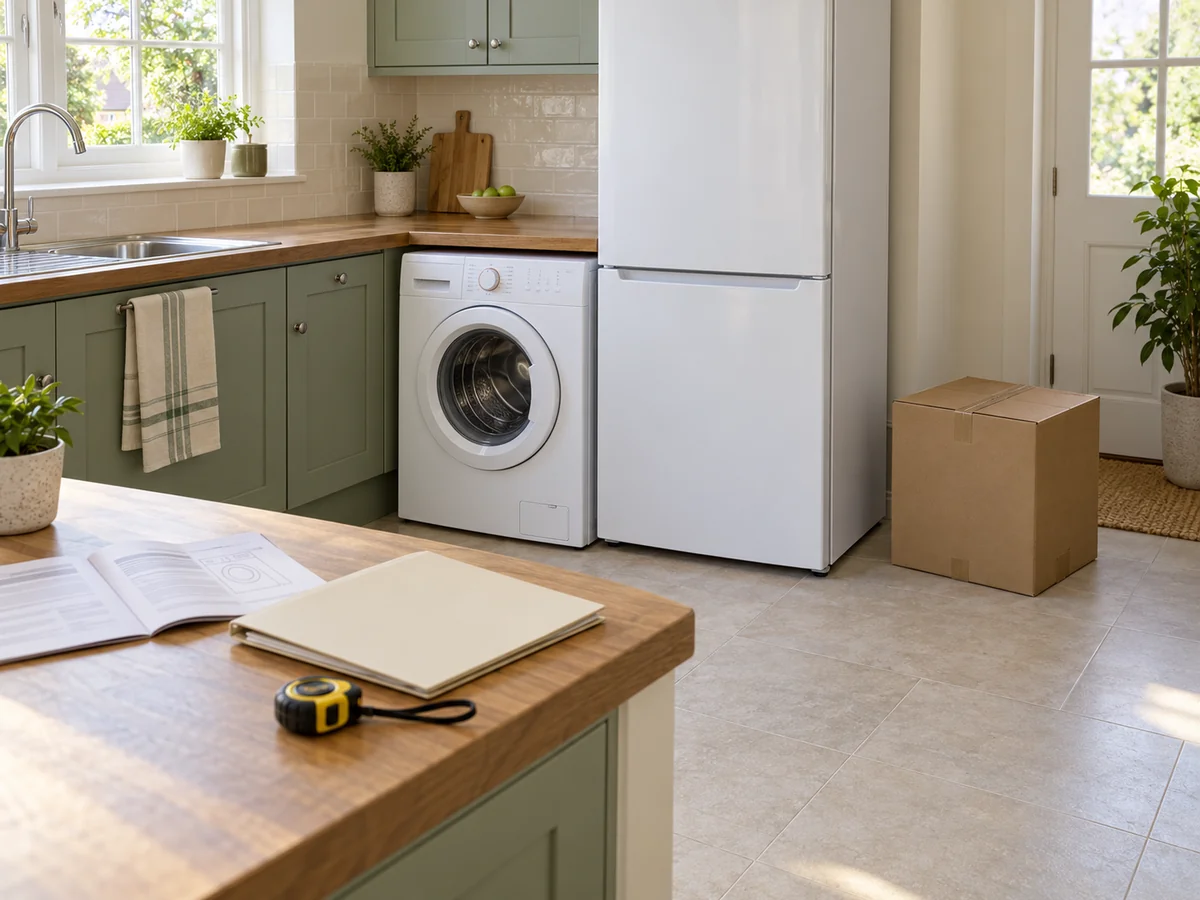
Plan appliance preparation before the removal vehicle arrives. A fridge, washer or cooker may need model-specific work, an accessible carrying route and a separate arrangement for installation at the destination.
Treat disconnection, transport and reconnection as distinct tasks. A booking to carry an appliance does not establish that the team will work on gas, fixed electrics, plumbing or integrated cabinetry.
Make an inventory of the appliances actually moving
Confirm which appliances belong to you and which will stay at the property. Check any relevant handover or tenancy arrangements before preparing an item for collection. Include integrated appliances explicitly rather than assuming they lift out like freestanding units.
Record the make, model and dimensions, then locate the installation and transport instructions. Keep these accessible with the move plan. If a model label is difficult to reach, ask for appropriate help rather than pulling a connected appliance out just to complete the list.
A useful inventory links each appliance to its preparation arrangements:
| Appliance detail | What to establish |
|---|---|
| Model and dimensions | Correct manual and route requirements |
| Connection and fitting | Who will assess and prepare it for removal |
| Transport preparation | Required parts, protection and handling arrangement |
| Destination | Space, access and a separately agreed installation plan |
This is a coordination record, not a disconnection procedure or a promise that an appliance suits the new property.
Arrange gas and electrical work separately
For a gas cooker moving to a different property, arrange the necessary work with a Gas Safe registered engineer qualified for that appliance. HSE's domestic-gas guidance distinguishes temporarily moving a bayonet-connected cooker for cleaning from installation or reinstallation. Do not treat a house move as that temporary cleaning exception.
Check who is doing the work and when, including what needs to be ready at each address. Do not ask the transport team to improvise an unagreed gas connection because the van is waiting.
Electrical appliances also need their actual connection assessed. A fixed electrical connection is not the same task as unplugging an ordinary plug. NICEIC's kitchen-electrics guidance provides context for arranging appropriate electrical work. Have a suitably qualified person confirm the requirements where fixed wiring is involved; this guide does not provide wiring instructions.
Check washing-machine transport preparation
Find the transport instructions and any parts retained for your particular machine. Bosch's moving guidance includes securing the drum with its transit bolts for a long-distance move and removing them again before use. That is a reason to check the correct preparation, not a rule for guessing parts on a different model.
If the required components are missing, resolve that through the manufacturer or suitable supplier before collection. Do not assume another machine's bolts or an improvised substitute will do the same job.
Arrange any water disconnection and residual-water preparation through the relevant instructions and agreed help. Let the mover know when the machine will actually be ready. Retain the preparation information for the person responsible for setting it up at the other end.
Allow time for refrigeration preparation
Plan when the fridge or freezer will stop being used and how the contents will be dealt with. Check the model's instructions for emptying, defrosting, drying, loose components and transport preparation. Leave time for that work rather than making it depend on the team's arrival.
Bosch's fridge-freezer moving guide covers route checks, preparation and handling considerations. Use your own manufacturer's instructions for the actual model, including its transport position and when it can be switched on afterwards. Do not rely on a single settling-time rule copied from another appliance.
Tell the receiving household if the appliance will not be ready for immediate use. The transport arrival time and the time it is properly installed, ready and cooled are different planning points.
Give integrated appliances their own preparation plan
Identify any cabinet doors, plinths, fittings or other parts that need attention before a dishwasher, oven or fridge can leave its space. Establish who is authorised and equipped to do that work, and who handles installation at the destination.
Do not start removing screws or pulling on a unit because it looks similar to a freestanding appliance. Keep the relevant model and installation instructions with the person doing the work. Record any retained components so they can be matched to the right appliance later.
Confirm the route and collection condition
Measure the appliance and any required protection against doors, turns, stairs and lifts at both addresses. Explain restricted loading access or long carries when arranging transport. The floor plan of the kitchen does not describe the whole carrying route.
Before collection, check the agreed preparation is complete and tell the mover about any change. Do not rush an unfinished disconnection or conceal remaining water, loose components or an unresolved fitting problem.
Use single-item transport for an individual appliance or include the items in a house-removals inventory. Confirm preparation and installation separately, with the qualified help required for the actual work. Keep manuals and the handover record accessible until setup is complete.

Liz
Liz is a content creator and digital marketing consultant. Originally from Toronto, Ontario, Canada, she is now happily settled in the UK (after living in four different countries across 2 continents and moving house 10 times). Drawing on her experiences, Liz shares practical advice and insider tips to help others enjoy smoother, stress-free moves.

Our Moving House Guides support homeowners and renters through every stage of relocating to a new property. At Find My Man and Van, we provide step-by-step advice on planning timelines, organising utilities, preparing furniture, and coordinating your move day efficiently. Whether you’re moving locally or further afield, these guides are created to help make your house move smoother, more organised, and less stressful.