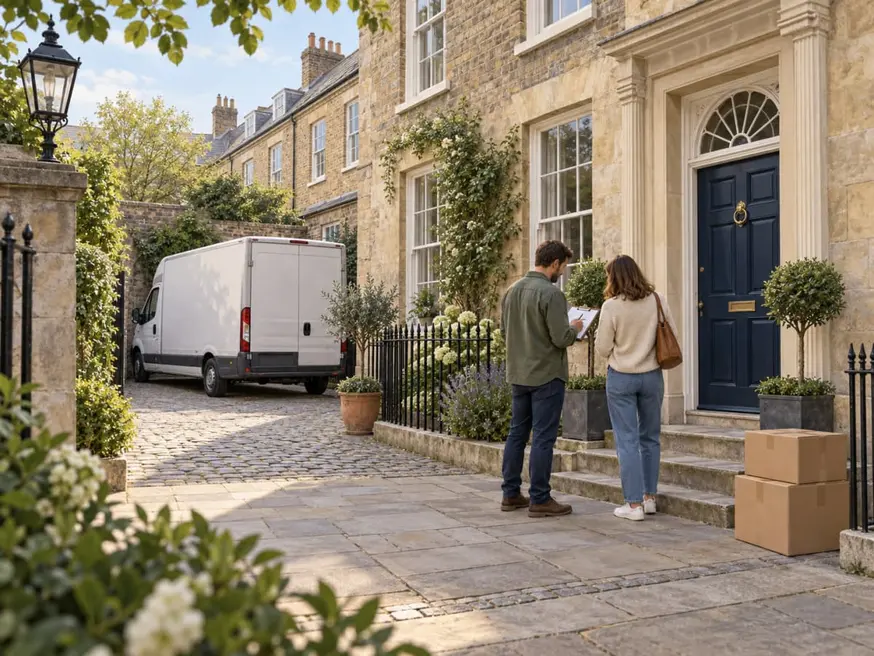
A move in a historic area needs two plans: one for getting the vehicle to a permitted loading place, and another for getting your belongings from there into the right room. A smaller van may help with a tight approach, but it does not automatically solve a pedestrian restriction, a narrow staircase or a difficult furniture turn.
Before booking, work through the whole route at both addresses. The most useful information is specific: the entrance you will use, where loading is permitted, the carrying distance and the dimensions of anything awkward.
Start with the route from street to room
Do not stop at checking the front door. Walk the route your largest items would take and record each constraint.
| Part of the route | What to check | What to share with the mover |
|---|---|---|
| Street approach | Barriers, access signs, tight bends and any posted vehicle limits | Exact entrance location and photographs of relevant signs |
| Loading position | Where the vehicle can legally stop and whether an application is needed | Proposed location, permitted times and any written approval |
| Carrying route | Distance, steps, slopes, uneven surfaces and shared paths | Approximate distance and photographs of obstacles |
| Building entrance | Clear opening, steps and space to turn immediately inside | Measurements and photographs with the door open |
| Internal route | Hallway turns, landings, stairs, low ceilings and lift access | Tightest points and any building rules |
| Final room | Doorway clearance and space to turn or assemble an item | Intended destination for each awkward item |
Check furniture in its transport condition, including whether legs or other parts can be removed appropriately. Measurements help identify a problem; they do not by themselves prove that an item can turn through a landing. Ask for the proposed route to be assessed if the fit is uncertain.
Check the exact street, not just the town
Historic centres can have different rules on neighbouring streets. Check the local authority's current guidance for your address and date, then ask about anything unclear before agreeing a loading window.
York shows why this matters. Its council lists general footstreet hours of 10.30am to 5pm, but also identifies streets with additional restrictions. Shambles and Stonegate are closed to general traffic and protected by bollards, with vehicle access requiring authorisation or prior arrangement. Their listed loading windows differ. An early arrival alone does not settle whether your vehicle can enter. Consult the City of York footstreets guidance and street map.
Record the official answer alongside your move details. Include who you spoke to, any reference number and the access conditions. Check again if your date, vehicle or loading location changes. The York example illustrates the questions to ask; it is not a rule for other towns.
Separate access permission from a loading place
Being allowed into a street and being allowed to stop in a particular place are separate checks. Ask the relevant council or landowner what applies to the precise location. Do not assume an ordinary parking permit reserves enough room for the moving vehicle.
For example, Westminster accepts parking bay suspension applications for removal vans used in house and office moves. Its guidance distinguishes bay suspensions from yellow-line dispensations and provides a separate process for housing estate land. Check the current application arrangements, notice requirements and charges on Westminster's parking bay suspension page.
Agree who will apply, who will pay and who will share the approval with the mover. Avoid treating an application as confirmed permission. If the intended space is unavailable, agree a lawful alternative and tell the mover about the changed carrying route.
In England, Scotland and Wales, waiting and loading restrictions are not interchangeable. Government guidance explains yellow-line waiting restrictions, additional loading restrictions and red-route controls. Read the signs and markings together; yellow lines alone are not enough to establish that loading is allowed. Use the Department for Transport guide to parking signs and road markings alongside local instructions. For an address in Northern Ireland, check the relevant local and Department for Infrastructure guidance.
Choose the vehicle after checking the load and access
A smaller vehicle is useful only if it can carry the agreed load and reach an appropriate loading position. A larger vehicle may reduce trips, but its approach, stopping space and loading arrangement still need checking.
Compare the options against the same inventory and access plan:
- Can the largest item fit through the vehicle's actual loading opening?
- Is the vehicle suitable for the complete load, including its weight?
- Is there room for any agreed loading equipment to operate?
- Would extra trips fit within the confirmed access window?
- Has the mover agreed the people and equipment needed for the carrying route?
Use the man and van size guide for initial planning. Confirm the actual vehicle and arrangements for your booking. Do not assume several smaller trips will be quicker or cheaper than one larger move.
Plan difficult handling before moving day
Cobbles, slopes, steps and confined turns deserve attention before anybody starts lifting. Describe these features when requesting your move, including any fragile surfaces or building restrictions that affect the route.
The Health and Safety Executive's workplace guidance puts avoiding hazardous manual handling first, followed by assessing unavoidable handling and reducing the risk. Extra helpers or a trolley are not substitutes for assessing the task. See HSE's manual handling guidance.
Ask the mover to confirm how the difficult items will be handled and what equipment, if any, is appropriate and included. Do not improvise a ramp, remove part of the building or assume an external furniture lift is available. If the route cannot be agreed, resolve that before the move rather than relying on the team to force an item through on the day.
For item preparation, read the moving heavy furniture guide. Flag valuable or unusually fragile pieces separately so that handling and applicable cover can be discussed for those items.
Prepare one access note for each address
Bring the information together in a short note you can share when arranging the move:
Address and entrance:
Moving date and confirmed access times:
Proposed loading place and approval status:
Person arranging permission and reference number:
Carrying distance, surface, steps and slopes:
Doorways, turns, stairs or lift restrictions:
Largest or most awkward items, with measurements:
Agreed loading help and any special arrangements:
Unresolved questions and contact on the day:
Keep an unresolved point marked as a question. “Access to be confirmed” is more useful than an optimistic assumption that later becomes part of the booking plan.
Choose the service around the whole move
For a smaller inventory, start with man and van services. For a full household, review house removals. Give the same inventory and access information whichever option you consider, and check what the proposed service includes.
When arranging a move through Find My Man and Van, provide both addresses, the date, the items and the loading help you need. Explain restrictions and uncertain access before confirming the arrangements. Read how pricing works and check the terms for your move, including any additional arrangements you need.
Before the vehicle arrives
Recheck access notices, keep permission details available and make sure the agreed building contact can be reached. Have the packed inventory ready and tell the mover promptly if an item or access condition has changed. If a planned loading place is blocked or a route is unsafe, contact the mover and the relevant authority or property manager to resolve it before proceeding.
Local sources reviewed on 25 September 2026. Check the guidance for your exact street and moving date, as arrangements can change.

Liz
Liz is a content creator and digital marketing consultant. Originally from Toronto, Ontario, Canada, she is now happily settled in the UK (after living in four different countries across 2 continents and moving house 10 times). Drawing on her experiences, Liz shares practical advice and insider tips to help others enjoy smoother, stress-free moves.

The Man and Van Guides from Find My Man and Van are designed to help you understand how man and van services work, when they’re the right option, and how to get the best value for your move. From van sizes and loading tips to short-notice bookings and single-item moves, our expert guides break down everything you need to know before hiring a man and van anywhere in the UK.