
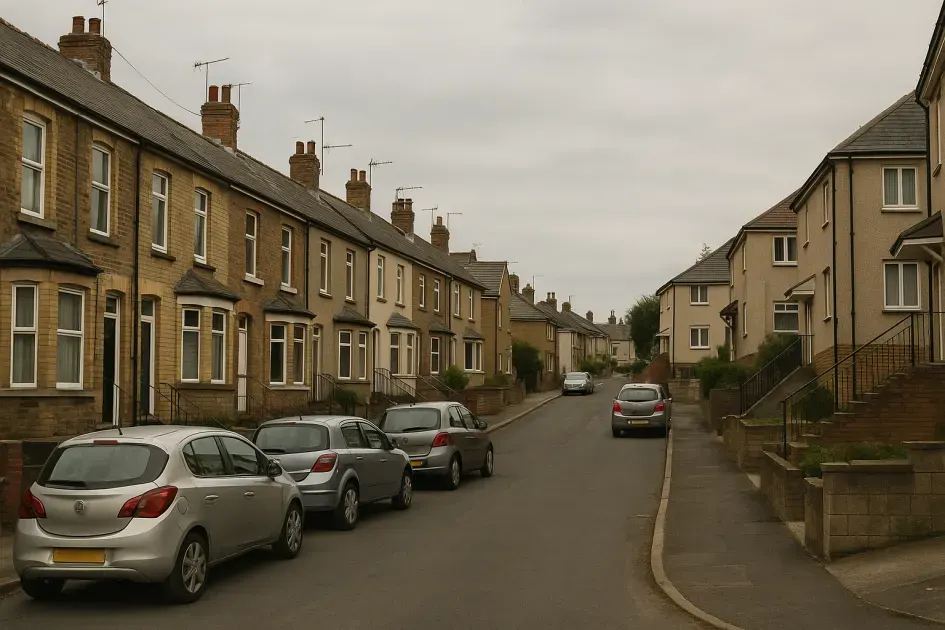
Packing decisions in Pontypridd must respond to the town’s mix of older terraces close to the river, converted flats above shops, semi‑detached suburbs and newer housing developments on the town’s fringes. Each location creates different practical constraints: narrow staircases in Victorian terraces, lifts with tight dimensions in some purpose‑built blocks, short front gardens and kerbside parking limits in town centre streets, and estate roads with limited turning for large vehicles. Planning with these realities in mind reduces handling time and the risk of damage.
Typical Pontypridd terraces often feature narrow hallways and steep, winding stairs. Pack into smaller boxes (12–15kg maximum) so a single person or a two‑person team can manoeuvre them without awkward repositioning. Disassemble beds, remove legs from sofas and wrap long items like mirrors or picture frames in edge protection to prevent snagging on tight corners. Because landings are often shallow, measure the widest pieces before moving day to avoid discovering an item won’t pivot past a stairturn, which would require time‑consuming onsite disassembly.
For a broader regional view, see Cardiff moving timing guide.
For the next planning step, compare this issue with best time to move in Pontypridd and moving guide for Pontypridd so the booking page can stay focused on the actual move rather than duplicate planning detail.
removals in Pontypridd is the main booking page for checking availability, pricing and move details in one place.
Converted flats above retail premises or in older stone buildings frequently lack lifts; plan as for multiple stair carries and limited doorstep access. Purpose‑built blocks on the outskirts may have lifts, but not all lifts can take beds or wardrobes. Measure lift internal dimensions and advertise box sizes accordingly when packing. For no‑lift situations, use soft packing (e.g., duvets and wardrobe boxes for textiles) to keep loads flexible, and consolidate fragile items into fewer, better‑protected boxes to reduce the number of delicate carries.
Semi‑detached houses around Pontypridd often provide driveway space that shortens carry distances. Newer estates can give the impression of easy loading but frequently have narrow access roads, parked cars and estate management restrictions. Verify if a turning area exists for the removal vehicle and whether the estate requires prior notification for large vehicles. Even with parking close by, measure doors and lift capacities in adjacent blocks to avoid rework on the day.
Long carry distances are common when parking is restricted to side streets, permit bays or municipal loading areas. For carries across uneven pavements, bridges or narrow alleyways you should:
Every additional 10–20 metres of carry adds handling time and labour cost: plan for this in your schedule and when estimating labour needs.
Label with the carry path and final location in mind. A practical local system is colour‑coding by floor (ground/first/second), plus room label and a load sequence number. Example: Blue/Ground/Kitchen/Box 6. Add orientation arrows and a short note if a box must go up or down stairs (e.g., “UP 2nd”).
Loading order on the vehicle should mirror the unloading route from street to property: load items that will be delivered last first. For multi‑floor deliveries where parking isn’t adjacent, mark boxes that can be staged near the kerb so they don’t block the doorway during repeated carries. This reduces double‑handling and cuts unloading time.
Common tight access scenarios in Pontypridd include narrow terraced streets, short front gardens with low gates, and town‑centre kerbs with limited loading windows. Before moving day:
Allow extra time in estimates for awkward positions: what looks like a simple sofa move can turn into a 30–60 minute operation if the van must park 20 metres away and the piece cannot be tilted through the entrance without disassembly.
Uploads and carries in Pontypridd vary more than in towns with uniformly wide streets. Tight terraces and no‑lift flats increase labour time and therefore cost; drives and nearby parking reduce it. As a rule of thumb, budget an extra 30–90 minutes of labour for terraced or no‑lift flat moves versus equivalent sized semi‑detached properties with driveway access. Also factor in potential permit application lead times and possible estate or council restrictions on vehicle size and time windows.
For a detailed timeline that ties into local scheduling and seasonal considerations, see the moving timing guide: Cardiff moving timing guide. For background on the best times to move in Pontypridd, including parking and local event impacts, consult: best time to move in Pontypridd. General information about removals in the Pontypridd area can be found here: removals in Pontypridd.
Local details matter: small differences in access on your street in Pontypridd will change how you pack and how long moving day actually takes. Preparing with precise measurements, protective materials and a clear labelling/load plan will reduce handling time and the chance of damage when moving in this varied South Wales town.
Answers to common packing concerns tied to Pontypridd property types, access and local restrictions — so you can plan time and cost more accurately.
Use smaller, well-secured boxes (aim for 12–15kg max) so each load fits a single hand and a step at a time. Disassemble bulky items and protect edges with blankets; keep a clear carry route by moving hallway furniture first. Allow extra carrying time — terraces in Pontypridd often have narrow halls and shallow landings that slow every trip.
Expect multiple flights and limited doorstep parking. Label boxes by floor and final room, and pack an essentials box for immediate access. For fragile items use extra wrapping; long carries from a permitted parking bay or town centre kerb can require waterproof covers and trolleys, adding time to loading and unloading.
New builds may have reserved parking and wider stair cores or lifts, but estate roads can be narrow with restricted turning circles. Measure lift capacity and door widths; disassemble wardrobes and beds if lifts are small. Planning helps avoid repeated trips and potential wait times for lift availability.
Every 10–20 metres of extra carry typically adds 10–15 minutes per heavy item due to repeated hoisting and careful handling. For a three-bedroom terrace with parking 30m away, expect an additional 1–2 hours on top of standard loading time; that impacts cost where labour is timed or staged.
Use colour-coded labels by floor (e.g., ground = green, first = blue) plus room names and a box number. Mark boxes with arrows for upright orientation and ‘stairs’ for items destined upstairs. A load-order sticker helps place boxes on the vehicle in the reverse order of unloading to reduce handling time.
The exact answer depends on the access route, loading position, building type and timing conditions in Pontypridd, but clear planning is usually the simplest way to reduce friction and avoid surprises.