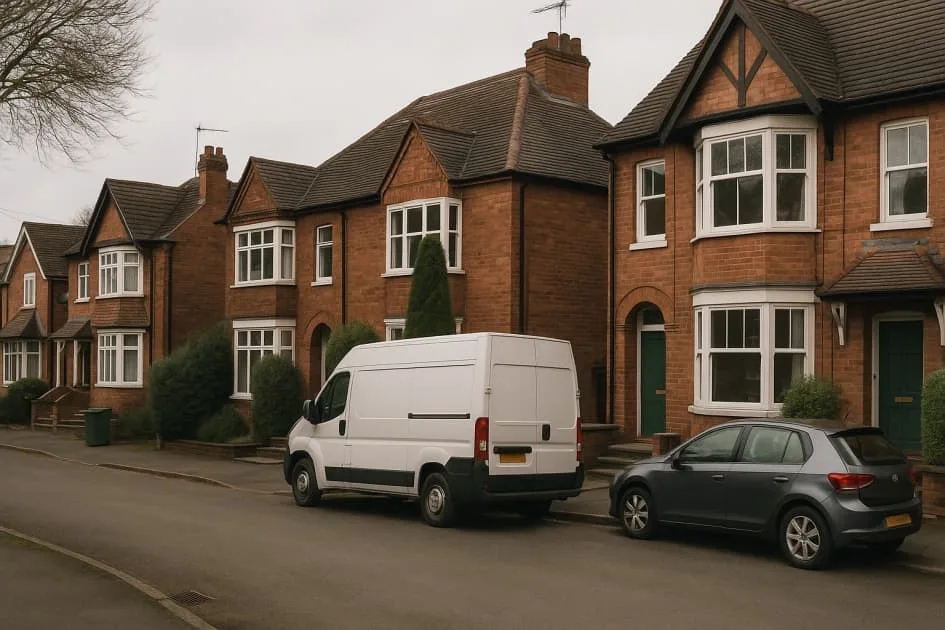
Sutton Coldfield Property Challenges – Access, Layout and Building-Type Friction

Sutton Coldfield property challenges are tied to the local building mix. Housing style affects how easily furniture leaves the property, how predictable access is, and whether the crew is working through clean internal routes or wrestling a sofa through awkward building layouts and tight access points.

Sutton Coldfield tends to be shaped by 1930s semi-detached houses with driveways in Four Oaks and Streetly, large detached houses on leafy residential roads around Little Aston edge and Four Oaks and post-war maisonettes and low-rise council housing around Falcon Lodge. For property challenges, that matters because that local housing mix often brings long front drives, stepped entrances that extend carry distance from van to door, variable lift access and crescent layouts, closes in suburban estates where turning space is limited for larger vans, which can turn an ordinary-looking address into a slower route with tighter corners, stair friction or awkward furniture angles.

Quick summary

  • Property difficulty usually comes from route geometry, not from distance alone.
  • Expect friction when access is shaped by long front drives, stepped entrances that extend carry distance from van to door and variable lift access.
  • External loading conditions can also be affected by resident parking pressure near boldmere high street, around wylde green station-side roads and driveway loading is common in four oaks, streetly but vehicles often need repositioning on shared drives.

Why property access behaves differently in Sutton Coldfield

Moves here are shaped by building reality, not just the postcode. In Sutton Coldfield, practical factors like resident parking pressure near boldmere high street, around wylde green station-side roads and driveway loading is common in four oaks, streetly but vehicles often need repositioning on shared drives and weekday commuter pressure shape how the day actually unfolds.

That matters whether you are arranging a studio move, a flat relocation or a larger household shift with vetted and approved drivers available through the platform. Clear planning protects time, and time is what usually protects the budget.

Local examples and planning scenarios

A straightforward job in Sutton Coldfield can still slow down when building access is sequential rather than parallel. One person may be waiting at an entry point while another handles the van, or the team may need to coordinate around lift use, side-street loading or a longer internal walk from courtyard to entrance. Those are ordinary local realities, not unusual complications.

That is why this page works best as part of a clear planning path. The man and van services in Sutton Coldfield is the main hub for this area. For one closely related angle, see moving costs in Sutton Coldfield. For a second supporting issue, review parking permits for moving in Sutton Coldfield. For broader regional context, see the moving guide for Birmingham. When you are ready to connect local planning back to the full service page, return to the Sutton Coldfield man and van page. For comparison with other cities, see our moving guides.

Practical advice before booking

  • Confirm exactly where the van can stop, not just the postcode or map pin.
  • Check whether any part of the route depends on fob entry, reception release or lift access.
  • Measure the longest internal path, especially if the property sits behind a courtyard or set-back entrance.
  • Note the busiest local time windows and avoid stacking the move into them unless there is a good reason.

Use this page as a planning layer, then use the Sutton Coldfield man and van page when you want to request the actual service. Support pages should clarify planning factors rather than duplicate the booking page. That way lies cannibalisation and other structural issues.


Sutton Coldfield Property Challenges FAQs

Common questions about building access and property layout in Sutton Coldfield.

Yes. Stairs and split routes affect every repeated trip, so they change the pace of the whole move rather than creating just one awkward moment.

In Sutton Coldfield, the hardest properties are usually the ones where the route is indirect rather than simply large. Property types such as 1930s semi-detached houses with driveways in Four Oaks and Streetly and large detached houses on leafy residential roads around Little Aston edge and Four Oaks can all create friction in different ways depending on how the access path behaves.

Very often. A converted building may look straightforward outside while hiding tighter stairs, less predictable lift access or longer internal routes once the job starts.

Yes. Lofts, garages and secondary storage areas spread the inventory across more space, which lengthens the loading phase even when the property looks manageable from the front door.

Measure doorway widths, stair turns, lift dimensions where relevant, and the real path from the furthest loaded room to the van position.

Because they can introduce waiting points, access control and route narrowing. They are manageable, but they need to be planned for honestly.