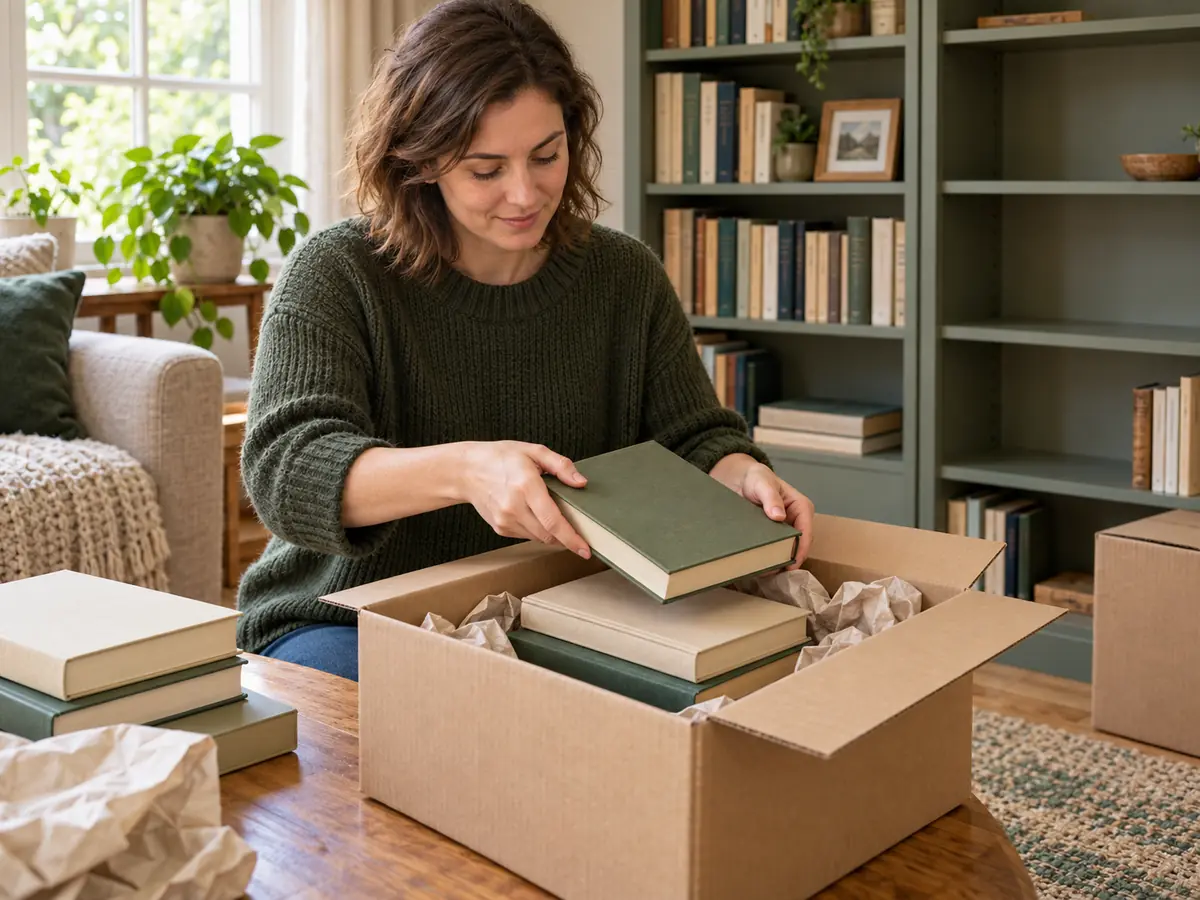
A book collection can turn into more boxes than you expect. Plan its packing separately from the bookcases so you can keep useful titles accessible, identify fragile items and tell the mover what the packed load actually includes.
The aim is a manageable collection of clearly recorded boxes, not the fewest possible containers. Take a small section of shelving as a starting point, then use what you learn to organise the rest.
Decide what needs to stay accessible
Before packing, separate books you will need during the move or soon after arrival. This might include work references, study material or a child's current favourites. Keep them with your accessible belongings rather than relying on remembering which sealed box contains them.
Choose whether the rest will be grouped by room, subject or shelf section. Use a system you can repeat consistently. If your shelves are already in an order you want to preserve, photographs of each section can help you rebuild it without making an individual record of every ordinary book.
Keep valuable, fragile or damaged editions on a separate list. Ask an appropriate conservator about books that need special support, rather than treating them as ordinary paperbacks or attempting a repair just before packing.
Choose boxes around the books and the route
The Library of Congress packing guidance recommends avoiding oversized boxes, supporting the load and padding empty spaces. For ordinary books, it describes packing flat with larger, heavier volumes underneath, or packing vertically with spines down. Do not force a book into a box or leave it carrying pressure on an awkward edge.
Check the box's condition and any stated capacity before using it. Choose a container that can be closed properly with the books inside; an impressive-looking large carton is not automatically suitable for a dense collection. If you are unsure about the packaging, agree the approach with whoever is packing or transporting the load.
Our box-selection guide covers the wider choice of containers. Apply that to the contents you actually have rather than buying a fixed bundle solely from the number of bedrooms in your home.
Pack a small section and review it
Start with ordinary books of similar size. Keep the contents supported and avoid cramming extra volumes into the final gap. Use the first completed box to check how the arrangement works before repeating it across the whole collection.
Do not assume that unused space must be filled with more books. Suitable packing can limit movement without making the box another heavy load. Keep packing materials from catching or marking delicate surfaces, and seek specialist advice for editions with unusual bindings or loose parts.
The Library of Congress cautions against self-stick tape as a book repair, including products marketed as archival. Apply parcel sealing and labels to the container, not directly to a book to hold its damaged cover together. Record an existing defect instead of hiding it under a hurried repair.
Keep the box record simple
A numbered record lets you find a group of books without opening every carton. Use a description that will still make sense at the new address:
| Box reference | Contents | Destination |
|---|---|---|
| Books 01 | Living-room shelf, upper-left section | Living room |
| Books 02 | Work reference books | Study |
| Books 03 | Children's books for later unpacking | Bedroom |
These are example labels, not capacity or stacking instructions. Keep any separate condition record for valuable books with your personal documents. Update the list if a box is repacked or divided.
Tell the mover the completed box count, any unusually large containers and whether bookcases are also travelling. Include stairs, lift arrangements and the distance from the loading position. A room described as a study does not establish how much its collection weighs or how it should be handled.
Make the handling arrangements explicit
Book cartons need to work for the route as well as their contents. HSE's manual-handling guidance explains that load weight matters but UK workplace rules do not set a single specific weight limit. That is not a target for a household box. Discuss the actual loads, carrying route and booked help instead of treating a numerical rule of thumb as a guarantee.
If a packed box is unsuitable for the agreed handling, divide or repack it before collection. Do not try to solve an overloaded box merely by adding a heavier label or expecting someone else to lift it. Keep the route clear and let the people handling the load decide how it should be moved.
Prepare the receiving space
Decide where the book boxes can go while furniture is being positioned. Keep them out of the active unloading route and tell the team which groups are needed first. If shelves need assembly or repositioning, arrange that before planning to unpack onto them.
For longer storage, choose conditions as carefully as packaging. The Library of Congress storage guide stresses the importance of the environment and warns against unsuitable temperature, humidity and leak-prone locations. A plastic container alone does not make an unsuitable storage area appropriate for books.
If books are going into a separately booked unit, use our self-storage moving guide to coordinate access and collection. Ask about suitability for your particular collection rather than assuming all household storage has the same conditions.
Unpack in a useful order
Use the box record to unpack what you need first. Check the books as you go and retain a record of any concerns, following the mover's reporting process where relevant. Do not discard all the packaging before checking the contents.
Rebuild the collection in stages, using shelf photographs if you took them. Keep specialist editions separate until their destination and support are ready. When the inventory and access details are clear, arrange house removals for a full household or discuss the actual collection through the appropriate transport booking.

Liz
Liz is a content creator and digital marketing consultant. Originally from Toronto, Ontario, Canada, she is now happily settled in the UK (after living in four different countries across 2 continents and moving house 10 times). Drawing on her experiences, Liz shares practical advice and insider tips to help others enjoy smoother, stress-free moves.

The Packing Guides at Find My Man and Van focus on helping you protect your belongings and pack efficiently for any type of move. From fragile items and bulky furniture to room-by-room packing strategies, our guides share proven techniques used by professional movers. With clear instructions and practical tips, we help you save time, reduce damage risk, and stay fully prepared for moving day.