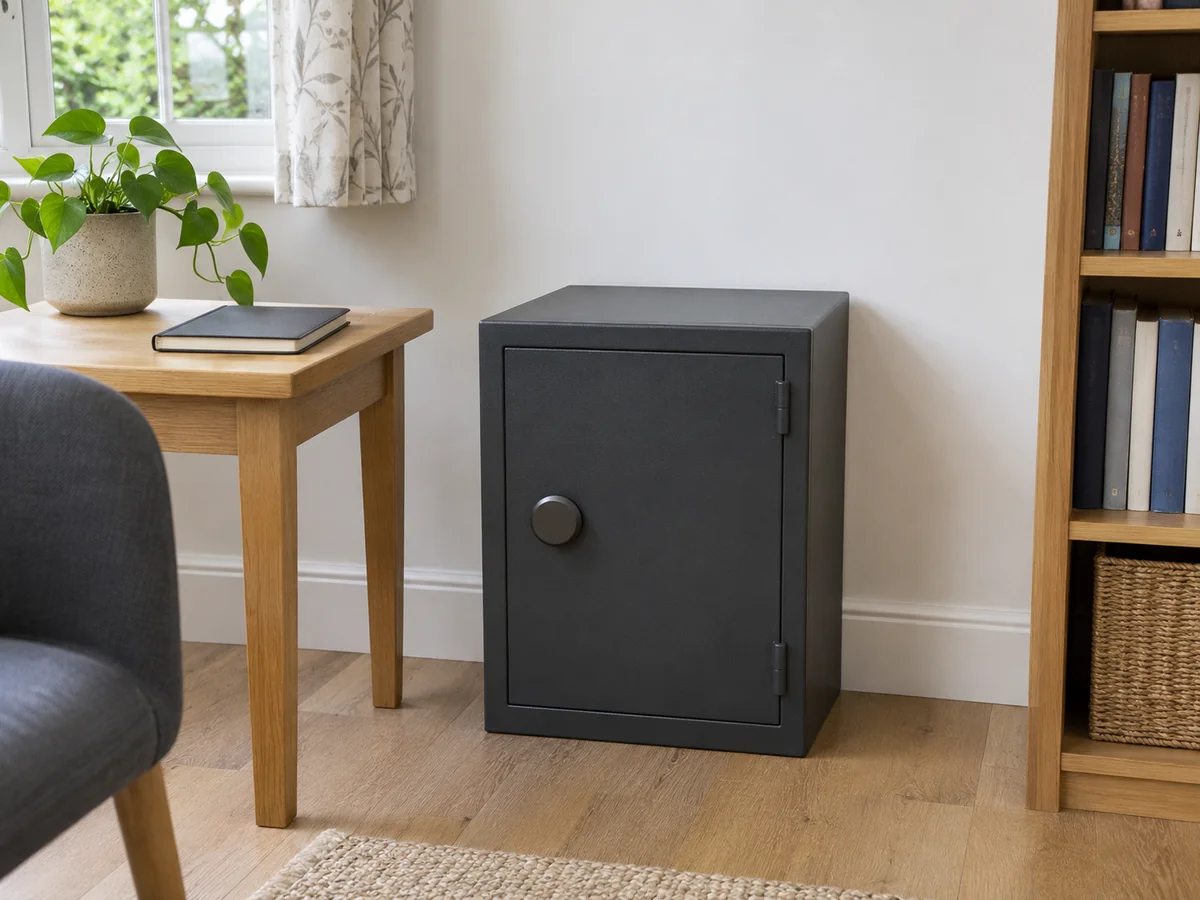
A home safe needs more planning than its place on a furniture list. The safe may be fixed to the building, its weight may be difficult to establish, and delivery is only one part of making it usable at the next property. Start with the model and a specialist assessment before deciding how it will travel.
This guide covers organising a UK home-safe relocation. It does not give lifting, opening, unbolting or installation instructions, and it does not establish that a standard household booking includes safe handling. Gun cabinets and the transport or storage of firearms are outside its scope.
Identify the safe without exposing its security details
Look for existing purchase documents, a model reference or the manufacturer’s information you already hold. Record the outside dimensions and a reliable model weight if available. Explain when the model or weight is unknown; a safe that looks compact is not necessarily comparable with another small cabinet.
Tell the assessor whether the safe is freestanding, fixed within furniture, built into a wall or floor, or otherwise installed. Describe its condition and any known problem with the door or lock. Do not pull it away from a wall, force it open or remove panels just to answer an enquiry.
Share photographs through an appropriate agreed channel, keeping combinations, keys, contents and unrelated documents out of view. Ask what information the specialist needs and who should receive any necessary access details. The general household inventory does not need to display how to open the safe.
Arrange an assessment of the whole job
Chubbsafes’ relocation guidance explains that moving large, heavy safes requires specialist equipment and experienced professionals. It highlights stairs, narrow passages and tight corners, and says an on-site evaluation may be necessary.
Give the specialist both endpoints, including the safe’s current position and intended final position. Provide the floors, changes of level, doorways, turns, lift information and distance to a lawful vehicle position. Include building access arrangements and anything you do not know about the route.
Ask whether the information is enough for acceptance or whether a survey is needed. A clear path to the front door does not settle the route from the safe’s installed position, and access into the new building does not prove it can reach its intended room.
The heavy-and-valuable-item guide explains the wider assessment and specialist-access handover. For a safe, add its installation and recommissioning needs to that plan rather than repeating only its dimensions.
Separate removal from the building and road transport
Confirm who assesses and completes any release from fixings, cabinetry or the building. Obtain the relevant property owner’s or manager’s permission for the proposed work, especially in rented premises or shared buildings. Resolve any required specialist or building advice before making the transport date depend on it.
Do not assume the collecting team will detach an installed safe or that ordinary furniture dismantling covers this work. Agree the condition in which the safe must be presented for collection, who will make it ready and who confirms completion.
If more than one service is involved, write down their handover point and responsibilities. One specialist might complete the installed-safe work, while another handles an expressly accepted later stage. Both need to agree that arrangement; a proposed division of work is not evidence that either party has accepted it.
Plan contents and access separately
Decide how anything currently in the safe will be dealt with before the appointment, using appropriate secure arrangements and the specialist’s preparation requirements. Do not assume contents are included in a booking to move the safe itself.
Keep a private record of items and the person responsible for them. Ask about applicable cover and exclusions for the actual safe, transport and any separate installation work. Discuss valuables with the relevant insurer or adviser instead of treating a general goods-in-transit statement as complete protection.
Agree who is authorised to admit the specialist and deal with access questions. Keep necessary security information separate from labels on moving boxes, and avoid circulating it to everyone involved in the wider house move.
Assess the final position and installation
Tell the installer where you propose to put the safe before the job is assessed. Ask about the actual floor or wall construction, suitability of the position, fixings and any further professional advice needed. Do not decide suitability from the safe fitting into an empty space.
Chubbsafes’ certification and installation FAQs explain that anchoring and unauthorised changes can affect certification and insurance. Follow the requirements for your particular model and obtain the installer’s and insurer’s advice; do not transfer one model’s fixing method to another safe or building.
Confirm what counts as completion: the agreed final location, installation work, relevant records and any checks or demonstration the specialist provides. Being unloaded in a hallway is different from being installed and ready for its intended use.
Coordinate the safe with the rest of the move
Agree the sequence with the specialist and household mover. Keep the assessed route clear at the required time, and explain if other furniture, cartons or appointments could obstruct it. Give everyone a named contact who can resolve an access question.
If a survey, permission or receiving position remains unresolved, keep that part of the plan provisional. Report material changes to the safe, route or building arrangements before the appointment rather than improvising a solution during loading.
When enquiring through Find My Man and Van, contact booking support with the safe and access details and obtain explicit confirmation of suitability before including it in the load. A normal quote does not establish specialist safe removal or installation. Keep the rest of your house-removals inventory clear about which work is separately arranged and which goods are accepted for household transport.

Liz
Liz is a content creator and digital marketing consultant. Originally from Toronto, Ontario, Canada, she is now happily settled in the UK (after living in four different countries across 2 continents and moving house 10 times). Drawing on her experiences, Liz shares practical advice and insider tips to help others enjoy smoother, stress-free moves.

Our Moving House Guides support homeowners and renters through every stage of relocating to a new property. At Find My Man and Van, we provide step-by-step advice on planning timelines, organising utilities, preparing furniture, and coordinating your move day efficiently. Whether you’re moving locally or further afield, these guides are created to help make your house move smoother, more organised, and less stressful.