
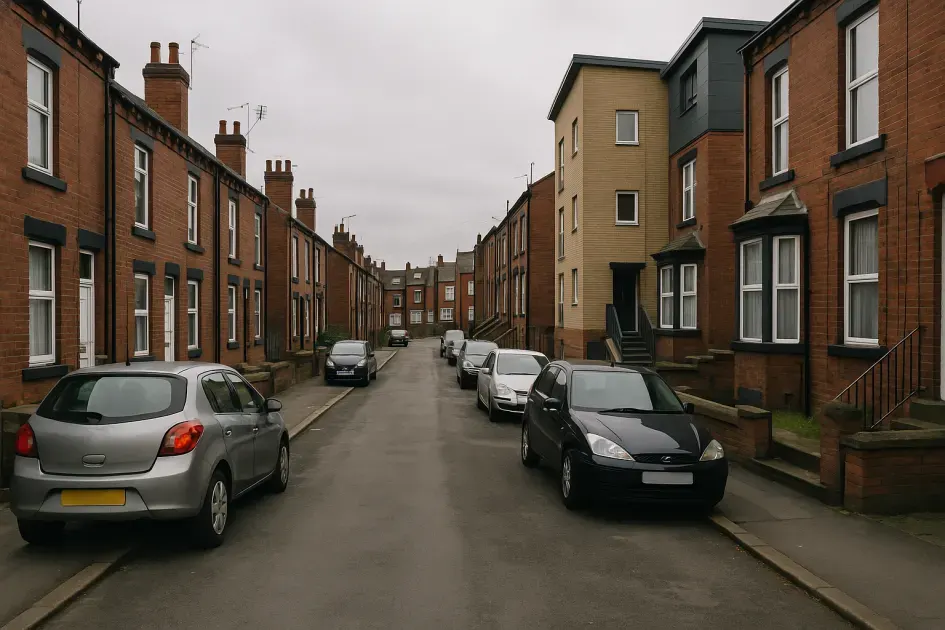
South Leeds covers a mix of housing types that directly affect removals operations: dense Victorian terraced streets in Beeston and Holbeck, mill-conversion flats and courtyard developments close to the river, semi-detached suburban properties in parts of Middleton and older new-builds around Hunslet and Morley. Those physical characteristics — street width, parking controls, lift availability and property layout — drive the practical, often-unplanned costs on moving day.
Many inner South Leeds roads operate controlled parking zones or resident permit schemes, and nearby streets can turn into one-way routes during school drop-off and pick-up times. If a removal vehicle cannot legally stop outside a property, crews must find a legal bay or a pay-and-display car park and then shuttle items to the front door. That adds loading time and increases the chance of receiving a penalty if incorrect parking is attempted. In practice this means extra porter hours and potential charges for arranging temporary loading permissions — both factors that lengthen the job and increase cost.
For a broader regional view, see moving costs in Leeds.
removals in South Leeds is the main booking page for checking availability, pricing and move details in one place.
Unexpected charges are easier to avoid when you this page with moving costs in South Leeds and property access challenges in South Leeds.
Holbeck and parts of Beeston contain converted mill blocks and gated courtyards where vehicle access is limited or requires scheduled loading slots. Even when a new-build does have a service road, narrow entrances or cobbled surfaces restrict vehicle positioning. Operationally, restricted vehicle placement increases carry distances and handling time: movers may need to negotiate staircases and thresholds repeatedly, slowing the loading bay turnover and extending the crew’s booked time on site.
Terraced houses on South Leeds streets frequently force removals teams to move items 30–150 metres between vehicle and doorstep — sometimes over uneven pavements or across cul-de-sacs. Each extra trip multiplies time per item; a handful of large pieces repeated across a full house becomes a significant addition to labour hours. For apartment blocks without immediate vehicle access, expect slower packing and higher porter requirements to avoid damage and meet health-and-safety limits.
Many flats are in converted Victorian buildings where stairwells are narrow and lifts are either small or absent. Even in new-build blocks the lift may not accept sofas or mattresses laid flat, requiring dismantling and two-person carries up flights of stairs. These constraints increase the number of staff required, the time per item and the risk of overrun penalties if the scheduled slot is exceeded.
Delays are common where access issues, parking searches or tenant timings interfere with an agreed start. When a vehicle must wait — for a permit to be issued, for keys, or for a neighbour to move a parked car — removal crews either incur waiting time charges or fall behind schedule, which can cascade into missed appointments and the need to rebook services. In practice that can mean paying for extra hours on the day or scheduling a second visit to complete the job.
Southbound approaches into central Leeds from the A61, local arterial routes and narrow residential streets can become congested during commuter peaks and school runs. Large removal vehicles may be delayed by temporary roadworks or loading restrictions on main streets, forcing longer detours onto residential roads not designed for heavy traffic. Those delays translate to higher travel time, increased fuel usage and, if booked back-to-back, penalties or rebooking needs.
If a job runs late because of access issues, crews may not reach subsequent bookings. Rebooking a missed slot typically involves travel costs, uplifted labour charges and administrative fees. In South Leeds this risk is elevated where parking is scarce and carry-in times are unpredictable — for example, replacing a short, city-centre street stop with multiple long carries through terraced lanes will often push an average move into overtime.
To reduce hidden costs, plan around local realities: check whether your street has a Controlled Parking Zone or resident-only bays; confirm lift dimensions in mill conversions and gated developments; allow extra time for carries on terraced streets in Beeston and Holbeck; and avoid peak traffic windows on A61/A639 approaches where possible. For more on how pricing reacts to these factors see /removals/leeds/moving-costs and local guidance at /removals/leeds/south-leeds/moving-costs. If you need practical details about the property or its street layout, the page for South Leeds removals at /removals/leeds/south-leeds contains local-access notes that are commonly overlooked.
Practical answers to common queries about where extra time and charges come from on moves across South Leeds, including terraced streets, mill conversions and new-build developments.
If a moving vehicle cannot load or unload immediately because of parking restrictions, waiting for a permit, or delays at the property, crews rarely stay idle: overtime or waiting-rate charges cover crew time. In South Leeds this commonly happens when a vehicle cannot access narrow streets in Beeston or Holbeck and must wait for a resident to move a car, or when permit-controlled bays delay unloading.
Many streets in inner South Leeds (parts of Beeston, Holbeck and Hunslet) sit within controlled parking zones or have resident-only bays. If there is no legal loading bay outside the property, operatives may need to park in pay-and-display bays or a nearby side street, creating longer carry distances and possible permit charges or civil parking penalties if rules are ignored.
Victorian terraces and converted mills in Holbeck and Beeston frequently have narrow staircases and tight landings that slow packing and safe handling. Where lifts are absent or too small for furniture, extra labour hours are needed. That increases both time on site and the number of crew members required to comply with safe-handling limits.
Peak-hour congestion on main routes (for example the A61/A639 approaches and arterial links into central Leeds) and deliveries queuing in restricted streets can push a scheduled job beyond its slot. If the outbound crew overruns, they can miss their next appointment, forcing rebooking and additional travel and labour costs.
Terraced streets and mill conversions with gated courtyards often mean the vehicle cannot stop at the front door. A carry across cobbles, through pedestrianised lanes, or down long drives requires more porter hours and slows loading cycles — a modest additional distance of 50–150 metres can add significant time when repeated across many items.
Surface the awkward details early. The more honestly the access route, loading position and timing pressure are described, the fewer surprises show up later as overrun.