
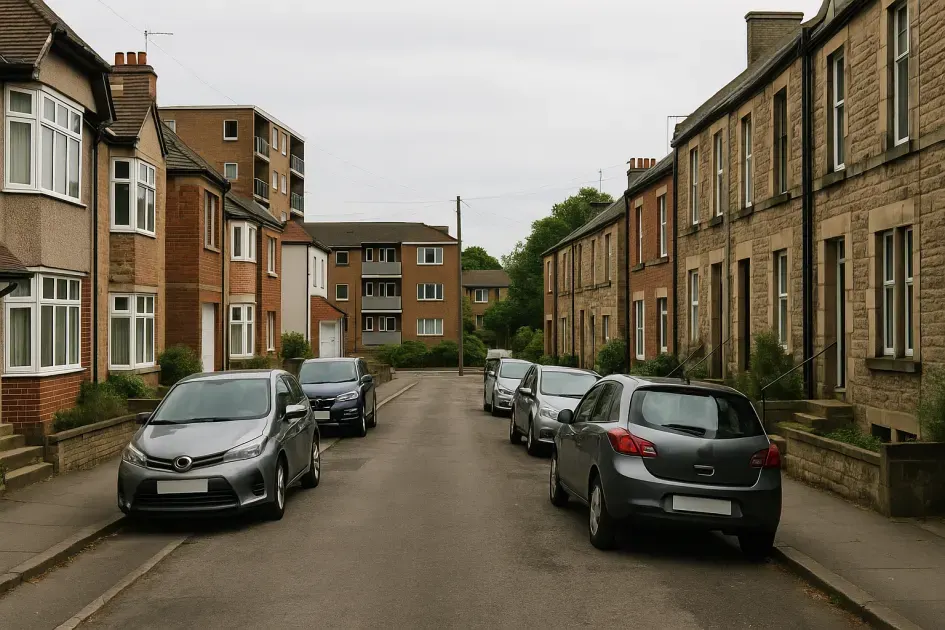
Many North Leeds neighbourhoods — Chapel Allerton, Headingley, Street Lane (Roundhay) and parts of Moortown — have short commercial stretches and resident parking controls. If a removals lorry needs to take a whole parking bay or sit on the kerb for loading, a parking suspension or temporary permit from Leeds City Council is often required. Applications take time and carry a fee; if not in place, crews spend extra time hunting legal parking or risk enforcement. That parking search and the enforced waiting time are real, billable operational delays.
Victorian terraced homes common in Headingley and Chapel Allerton have narrow hallways and twisted staircases. That slows every large item, often requiring dismantling at the property and reassembly at the destination — extra labour and materials that push up costs.
Use removals in North Leeds first for the core service page. For broader parent-area context behind price variation, see moving costs in Leeds.
Semi‑detached houses in suburbs such as Alwoodley or Moortown may look straightforward, but many sit on cul‑de‑sacs or have driveways set back from the road. The practical result is a longer carry from parked vehicle to front door, which increases loading/unloading time.
New‑build estates on the northern edges often use gated entrances, narrow estate roads and dedicated service yards with restricted access hours. A removal lorry might have to stop at the estate entrance and hand-carry items a long distance, or book a site manager to open gates — all of which add labour hours and administrative delays.
In practice, this usually connects with To spot where extra costs usually appear before booking, look at moving costs in North Leeds and property access challenges in North Leeds as well..
Flats above shops and modern apartment blocks around Roundhay and Moortown can have goods lifts that are too small for sofas, tall wardrobes or mattresses. When items don’t fit, crews must carry up stairs or dismantle furniture — each tactic increases time on site and therefore the bill. Some managed blocks require advance lift booking or specific moving hours; failure to pre-book often results in waiting-time charges when crews must pause until an agreed slot is available.
Areas with long garden paths, rear access only properties (common on converted terraces) or homes accessed down narrow ginnels create measurable operational friction. A parked vehicle on Harrogate Road or Otley Road may be 30–100 metres away from the house, and narrow pavements increase the effort and time to move boxes and furniture safely. Removals teams bill for the additional personnel and longer hourly usage of the vehicle when carry distances extend beyond a standard threshold.
Leeds City parking enforcement and busy shopping streets mean loading bays are often occupied. Crews arriving on a booked day can face queuing to access a bay or being moved on by enforcement officers. Time spent waiting while the vehicle is idle is usually itemised as waiting-time by operators because it uses crew and vehicle resources that were booked for a defined slot.
A move that looks like one run on paper can extend significantly in practice because of local traffic patterns: school pick‑ups on residential streets, market days, roadworks near the A61 Harrogate Road, and narrow one‑way residential streets in older suburbs. These delays add vehicle hours and can push a job past the booked time window — once a booking overruns, rebooking a second crew or a return journey may be necessary, increasing costs substantially.
Repeated stair carries in multi‑storey terraces or flights of stairs in split‑level homes increase physical demands and slow progress. The industry response is to add handlers or charge uplifted labour rates for stairable items. In North Leeds, many properties have non‑standard door heights or porch constraints that require two or more fitters to manoeuvre items safely — again, a tangible additional cost.
If a move runs late because a vehicle cannot park close enough, lift access is denied, or traffic causes delays on arrival/return legs, the result can be a forced rebooking of a second day. In neighbourhoods where parking suspensions must be reordered or concierge permissions must be renegotiated, the administrative lead time increases the chance of extra day charges and higher overall cost.
When planning a move in North Leeds, check whether your property is a terrace, flat above shops, semi‑detached or new build estate — each has different likely access issues. Factor in parking suspensions for high‑street locations and the possibility that lifts or estate managers must be booked. For broader cost context and typical charge types, see /removals/leeds/moving-costs and the parent area summary at /removals/leeds/north-leeds. For details specific to timing and bay suspensions in your street, consult the local authority guidance and allow extra time in the schedule to avoid enforced waiting and rebooking fees.
Answers to practical questions about extra charges driven by North Leeds property types, access restrictions and local traffic conditions.
Many terraces around Chapel Allerton and Headingley are Victorian properties with narrow frontages, tight staircases and no off-street parking. Removal vehicles often cannot park immediately outside, which increases carry distances and loading time. Crews typically charge additional labour and vehicle time when a van must be left on double yellows or parked meters away, and if a parking suspension isn’t arranged in advance, enforced waiting or repeated short trips can add significant cost.
Yes — for wide or long vehicles that need to occupy a parking bay or block a road, a parking suspension from Leeds City Council or the local ward office is commonly required. Applying for a suspension usually needs advance notice and carries a fee; failing to arrange one can result in enforcement action, delays while crews find legal parking and charged waiting time for any hold-ups.
New-build blocks and converted flats in areas like Roundhay and Moortown often have goods lifts too small for large items, or concierge/service-hour rules that require a booked lift slot. If wardrobes or mattresses must be taken down to fit, or if the lift is reserved and the crew cannot use it when expected, the result is extra labour time for dismantling/reassembly and waiting-time charges.
Key routes serving North Leeds — including Otley Road, Harrogate Road and local shopping arteries — have peak congestion, school drop-off peaks and daytime loading restrictions. Delays from traffic or from one-way systems and narrow residential lanes extend vehicle hours. Additional vehicle time is billed as waiting or travel time, and significant delays can force partial unloads or rebookings that add cost.
When a removal vehicle must park on a nearby main road because a street is too narrow, crews face long carry distances across pavements and through alleys. That increases loading time and often requires more staff to keep the schedule; many operators charge per carrying hour or per additional handler. Repeated stair carries in multi-storey terraces also attract uplifted labour rates because of the physical risk and slower pace.
Absolutely. When the internal path is longer than expected, every trip takes more time, and moving jobs are made of many repeated trips. The arithmetic becomes rude very quickly.