
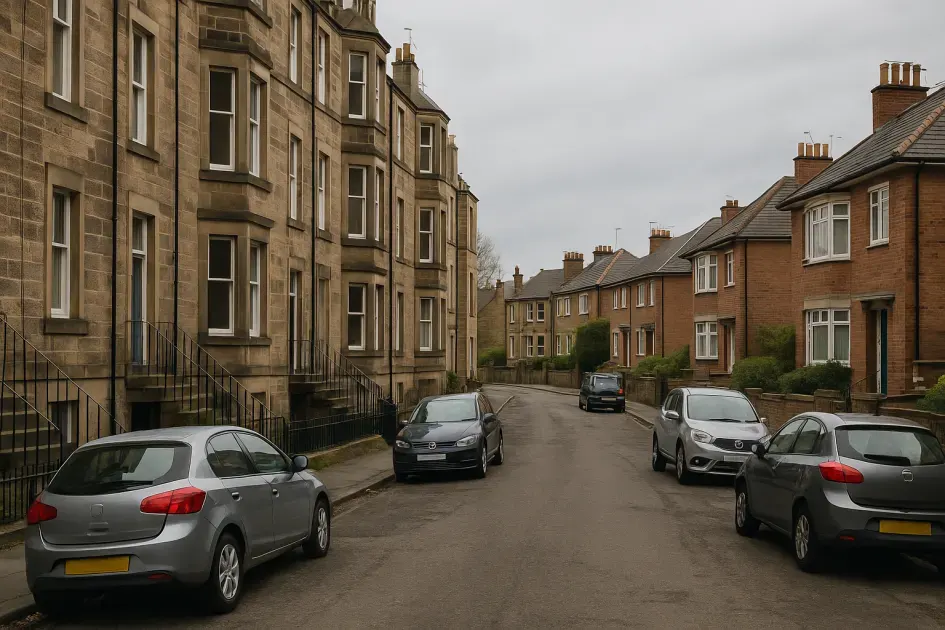
South Edinburgh’s mix of Victorian tenements, long gardened terraces, commercial high streets and modern estate developments creates specific operational frictions. These are not abstract risks — they directly affect how long a job takes, how many crew are needed, and whether additional charges, fines or rebooking become necessary.
Use removals in South Edinburgh first for the core service page. For broader parent-area context behind price variation, see moving costs in Edinburgh.
Each common property type in the south side presents different practical costs:
Many south side streets are controlled parking zones with single-yellow restrictions, resident-only bays or council-run loading bays. City of Edinburgh Council operates temporary bay suspensions and permit schemes for removals — arranging these late or not at all is a frequent local cause of extra expense. When a removal vehicle cannot use a convenient loading space, crews must park further away and use trolleys or repeated carries, which raises labour time and sometimes incurs parking enforcement penalties if bays are used incorrectly.
In practice, this usually connects with To spot where extra costs usually appear before booking, look at moving costs in South Edinburgh and property access challenges in South Edinburgh as well..
Commercial stretches such as Morningside Road and Bruntsfield High Street are busy with shoppers and deliveries; at peak times a suspended bay may be the only legal option for loading. Failure to secure it can result in penalty charge notices and lost time while a vehicle is moved on or relocated.
Waiting time arises from predictable local bottlenecks: waiting for access to a shared lift in a new-build block, queuing to use a narrow loading bay, or delays while a building concierge locates keys. In South Edinburgh, student move peaks and weekend high street traffic make these waits longer. Waiting is often billed in short increments; several small delays across a day compound into a large unexpected charge on the final invoice.
In parts of Marchmont and Newington, tenement flats place the van on the nearest main road, with multiple flights of stairs to reach front doors. That configuration turns what would be a 30–60 minute job into a multi-hour operation because each piece must be manoeuvred by hand. Terraced streets with low kerb access or uninterrupted parking also force crews to ferry items a long way on foot, increasing physical labour, causing delays and often requiring an extra person to stay on the job.
Traffic patterns in the south side are a practical factor: commuter peaks on main arterial routes into the city reduce manoeuvring time for large vehicles, while narrow residential streets with parked cars can block access entirely. Local events (weekend markets, university move-in/out weeks, or roadworks on key routes) can make an agreed slot unusable at short notice. These delays lead to overruns, and because many removal crews operate tight schedules, one delay can cascade into rebooking costs for follow-on clients.
When a move overran on one job, the next bookings for that crew may be missed; in South Edinburgh where crews commonly run multiple jobs a day, this creates real rebooking costs. Rebooking can mean a second visit charge, additional travel time billed, or having to scramble for a different crew with higher short-notice rates. The risk is elevated in term-time and at weekends when demand is high in areas like Newington and Marchmont.
Mitigation here depends on local steps tied to South Edinburgh’s realities: check whether your street is in a controlled parking zone and apply for bay suspensions early through City of Edinburgh Council; confirm lift booking policies and narrow stair clearances in tenement flats and new-build blocks; plan moves outside commuter peaks on Morningside Road if possible; and factor in additional crew time for flights of stairs common in Marchmont. For more detail on typical pricing impacts, see the broader guide on moving costs in Edinburgh and the parent South Edinburgh removals page at removals in South Edinburgh. For a breakdown of costs commonly seen in this neighbourhood, review moving costs in South Edinburgh.
Addressing these South Edinburgh-specific factors before moving reduces the risk of fines, waiting time charges and costly rebookings — and gives a clearer picture of how property type and local access shape the final cost.
Short answers to the most common local surprises — from council parking rules to extra labour for tenement staircases and weekend traffic on Morningside Road.
Possibly. Many streets in Marchmont, Newington and Bruntsfield are in controlled parking zones; City of Edinburgh Council permits or a temporary bay suspension are commonly required to reserve a loading area. Applying too late, or stopping in a restricted bay without authorisation, can produce a penalty charge and also force crews to park further away, increasing labour time and cost.
Victorian tenements in Marchmont and Newington often have narrow, steep staircases and no lift, which slows loading and unloading and frequently requires extra crew or longer booking slots. Conversely, some newer build blocks near the city outskirts have lifts too small for sofas or require lift booking windows — both scenarios add labour hours and handling time.
Typical causes are delays while arranging bay suspensions, waiting for building concierge or lift access in purpose-built flats, queues at loading bays on Morningside Road or Bruntsfield High Street, and traffic congestion during commuter peaks. Waiting is usually charged in short increments and can add significant cost if multiple hold-ups occur.
Yes. Narrow residential streets, busy shopping stretches and unexpected roadworks can make large removal vehicles impractical on the booked day. If the crew cannot load or unload within the scheduled time window due to road restrictions or local events, the job may overrun or need to be rescheduled — both of which push costs up and complicate subsequent bookings.
Many South Edinburgh terraces and some semi-detached houses have limited kerbside access: parked cars, tree-lined pavements and stepped front gardens mean crews must carry items further. Every extra 10–20 metres of carry multiplies handling time, increases risk of damage, and typically triggers additional labour time on the invoice.
Because the crew spends more time walking, repositioning and waiting. In South Edinburgh, where factors such as permit-controlled bays, pay-and-display streets where loading needs advance planning and short kerb availability on tenement streets, often requiring loading from the opposite side or nearby side roads are common, a weak stopping position becomes a tax paid in minutes.