
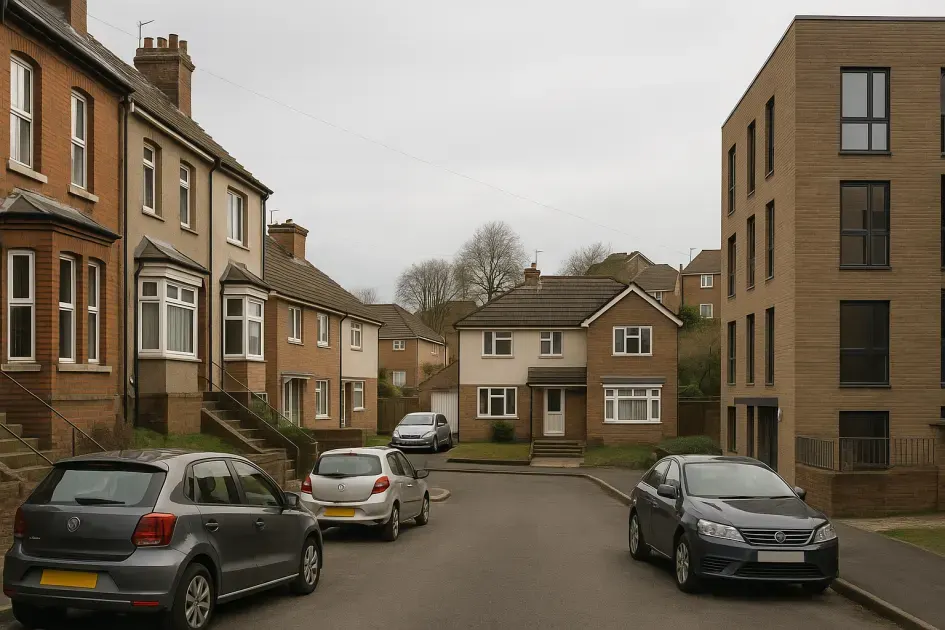
Much of Caerphilly’s central housing stock consists of older terraced rows built in the 19th and early 20th centuries. These houses often have narrow front doors, tight internal hallways and short, steep staircases. In practice this means sofas, wardrobes and tall cabinets frequently need to be tipped, turned on edge or broken down to pass through openings. Rear alley access is common, but those alleyways are gated with narrow pedestrian widths — not suitable for trolleys or direct vehicle access — so removal teams face longer carry distances from the nearest legal parking space. Expect the restricted geometry to add significant manual handling time and the possible need for additional crew or an alternative vehicle layout to split items for reassembly on site. See the local removals overview at /removals/cardiff/caerphilly for neighbourhood context.
Flats in Caerphilly range from purpose‑built blocks with small lifts to conversions of period townhouses with narrow, winding staircases. Lift cars in many blocks are shallow and have limited door clearances; when a lift cannot take a piece of furniture, every item must be carried by hand. Communal hallways and corridor turns increase the risk of damage to plasterwork and joinery, requiring protective wrapping and slower progress. Many apartment buildings impose time restrictions for moves and ask for lift reservations through management committees or housing associations — factor this into scheduling and avoid peak times around school runs and the town centre market days.
removals in Caerphilly is the main booking page for checking availability, pricing and move details in one place, while access and property guide for Cardiff gives broader regional context on property and access conditions.
Caerphilly’s town centre streets and older terraced lanes are frequently too narrow for standard removal lorries to park immediately outside properties. Kerbside parking is heavily used near the High Street, supermarkets and train station, and residents' parking zones operate across much of the town. Where parking close to a property is not possible, removal teams must carry goods over longer distances, increasing labour time and the number of handling movements (each movement increases the risk of scuffs and damage). Temporary parking suspensions, delivery bays and on‑street loading controls may be required on the busiest streets; these require advance application and can add both time and cost to the operation. For a broader view of access considerations across Cardiff and surrounding towns, consult /removals/cardiff/access-and-property-guide.
Neighbourhoods outside the town centre — for example larger semi‑detached suburbs and newer estates — generally allow easier access for larger vehicles and shorter carry distances. That said, many suburban streets are arranged as cul‑de‑sacs or have tight turning radii that prevent straightforward lorry positioning. Traffic during school start and finish times around local primary schools can create short‑term congestion that delays loading and increases parking enforcement risk. In denser pockets by the castle and market, expect slower loading and increased need for protective packaging because of higher pedestrian traffic and narrow unloading footprints.
Access issues usually sit alongside other planning points, so compare this page with moving guide for Caerphilly and hidden moving costs in Caerphilly.
New build homes around the outskirts of Caerphilly benefit from modern door widths and internal layouts that usually speed internal handling. However, estate design often channels larger vehicles to estate entrances, leaving visitor bays or allocated parking some distance from the front door. Site management on new developments may also have rules about vehicle weight on estate roads or times when large vehicles may attend — failure to coordinate can lead to denied access on the day. Older properties, by contrast, present tighter internal geometry and fragile architectural features (sash windows, narrow skirting boards and cornices), requiring slower careful handling and more protective materials. Both situations demand bespoke planning: in new estates the friction is about vehicle positioning and permissions; in older properties the friction is about manual handling and risk of damage.
Because Caerphilly’s housing stock and street layout vary so much over short distances, removal operations require local reconnaissance and specific planning. Real-world implications include longer carriage times (often adding 30–90 minutes or more for tight terraced properties), potential hiring of additional crew for heavy stair carries, the need for smaller vehicles or shuttle runs where roads prohibit large lorries, and possible council or estate permissions for suspensions or lift bookings. These factors directly affect the labour hours billed and the logistics lead time — moving from an older terrace near the town centre will typically cost and take more time than a move from a suburban semi‑detached property where kerbside access is available.
Survey your property and immediate street in daylight to identify likely parking spots, alley gates, and stair geometry. Note any communal rules for flats and contact building management to confirm lift availability and permitted move times. Where kerbside access is limited, consider routes for a shuttle from a legal parking area and allow extra time for packing, wrapping and careful manoeuvring in constrained interiors. For further practical local guidance about moving in Caerphilly, visit /removals/cardiff/caerphilly and the broader access guide at /removals/cardiff/access-and-property-guide. For detailed checklists tailored to Caerphilly properties see /removals/cardiff/caerphilly/moving-guide.
Concise answers to common property, access and operational questions specific to Caerphilly neighbourhoods and building types.
Many central and older residential areas around Caerphilly town centre and neighbouring villages (for example Senghenydd, Nelson and Abertridwr) have mid‑terrace Victorian streets with narrow front doors, short front gardens and rear alleyways. These features typically increase carry distances and require two‑person carries up narrow corridors and stairs, adding 30–90 minutes to a standard move and sometimes requiring smaller vehicles or additional labour to manage tight manoeuvres.
Converted Victorian townhouses and some purpose‑built blocks in Caerphilly often have small communal stairwells or lifts too small for large items. Lifts, where present, frequently have weight and size limits and may need advance booking with estate management. If stair carries are necessary, plan for slower progress and extra handling, particularly on properties near the town centre around the High Street and areas close to Caerphilly Castle where buildings are older and staircases steeper.
Several streets in the town centre and in older estates are narrow or include one‑way sections that prevent large lorries from getting close to properties. Public parking bays, residents' permit zones and short loading windows around shops and schools can force longer carries from parked vehicles. Organising a temporary parking suspension or choosing a smaller vehicle increases planning time and cost; allow extra time for council permissions and for positioning the vehicle on narrow lanes or cul‑de‑sacs.
New build developments on the outskirts (for example recent estates around Bedwas and Ystrad Mynach) tend to have modern access but bring other constraints: narrow estate roads, visitor bays rather than kerbside parking, and estate management rules on delivery vehicle access. Although doorways and hallways are usually wider than in older homes, long drives from parking to front door and restrictive estate layouts frequently add handling time and require coordination with site managers.
Suburban semi‑detached homes in areas like Van and parts of Caerphilly Basin usually offer better kerbside access and short carry distances, but individual cul‑de‑sacs and on‑street permit parking can still slow loading. These properties often allow larger vehicles to park nearby, reducing handling time, but planners should still assess local parking controls and any school drop‑off congestion that can affect arrival and loading windows.
Yes. Lofts, garages and secondary storage areas spread the inventory across more space, which lengthens the loading phase even when the property looks manageable from the front door.