Most Hackney moves don’t exceed budget because of “extra boxes”. They exceed budget because of time multipliers — kerb access delays, longer carry distances, shared lift queues, peak congestion, and small access constraints that were not factored into the original time estimate.
In a borough defined by dense terraces, flat conversions and limited kerb space, small inefficiencies compound quickly. Because man and van pricing is based on the hours booked, extended duration — not separate line items — is what typically increases total cost.
For the London-wide overview of how pricing works, see man and van in London.
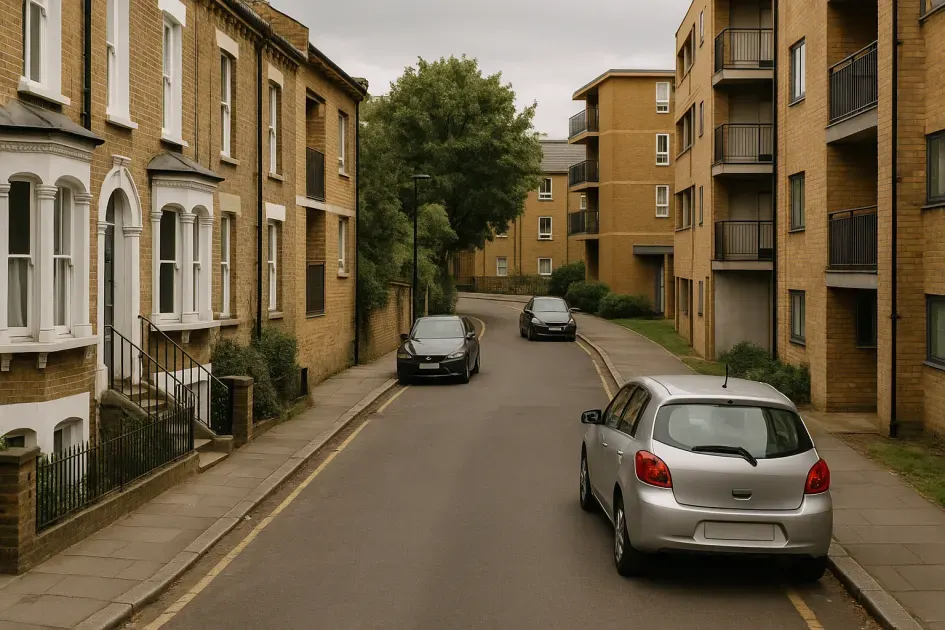
Hackney is extensively covered by Controlled Parking Zones (CPZs). In residential streets near London Fields, Dalston and Stoke Newington, legal stopping space can be limited during controlled hours.
The hidden cost is rarely a fine — it is usually time loss. If the van cannot position close to the entrance, each additional metre of carry distance adds minutes across dozens of trips. Ten extra minutes per loading cycle compounds into significant booked time.
High-demand streets and last-minute bay suspension issues further increase unpredictability. Where access is critical, confirm arrangements early: Hackney parking permits and suspensions.
Much of Hackney’s housing stock consists of Victorian and Edwardian terraces converted into flats. Raised entrances, narrow hallways and multiple stair flights are common.
Even when parking is technically legal, the internal route from kerb to property can be inefficient. A long corridor or tight stairwell increases “inside time” — and inside time is part of total job duration.
Warehouse-style developments near the Regent’s Canal and converted industrial buildings can reduce stair carrying, but longer communal corridors and shared entry systems introduce different friction.
If your property has access constraints, review: property and access challenges in Hackney.
The principle remains simple: distance and complexity increase time, and time drives total cost.
Many Hackney apartment buildings require advance lift bookings or restrict move-in hours. Some concierge-managed buildings impose time windows or require deposits.
Hidden costs arise when:
A 20-minute wait may appear minor, but if unloading is compressed into a restricted time slot, the total booked duration can extend beyond the original estimate.
Hackney contains several high-activity corridors and junctions. School runs, peak commuter overlap and weekend activity around markets or park areas can increase unpredictability.
Short geographic distances do not guarantee short travel times. When traffic slows transit between addresses, loading time at the destination begins later — reducing available buffer within the booked window.
For wider capital-wide considerations, including emission rules: London ULEZ guide.
Certain main roads include timed loading bays or stopping restrictions. Temporary works, diversions and event days can also affect kerb access.
These rarely introduce separate charges. Instead, they increase delay risk. If a van must reposition repeatedly or wait for legal loading windows, the booked hours are used more quickly.
Across London, parking and congestion influence duration. What makes Hackney more sensitive is density. Compared to outer boroughs with driveways and wider suburban roads, Hackney properties depend almost entirely on kerbside access.
In lower-density areas, minor congestion may add minutes. In Hackney’s tighter grid, similar congestion can cascade across repeated carry cycles, amplifying total duration.
For full pricing context, see: typical moving costs in Hackney.
Clear information about access, parking and timing reduces unpredictability and helps keep the move within the intended duration. Start here: man and van in Hackney.
Common questions about unexpected moving costs in Hackney, including parking delays, lift access, CPZ rules and how timing influences total duration.
In most cases, increases are linked to extended time rather than additional items. If loading takes longer than expected due to restricted parking, long internal carry routes or building access delays, the booked hours are used more quickly.
Because pricing is structured around time, any factor that slows loading or unloading can affect the final duration.
Yes. Hackney’s Controlled Parking Zones and limited kerb space can make positioning the van more difficult, especially during peak hours. If the vehicle cannot stop close to the entrance, each additional metre of carry distance increases handling time.
Over multiple trips between van and property, this added time can extend the total booking.
Some Hackney developments require advance lift bookings or restrict move-in windows. In converted warehouses or concierge-managed buildings, waiting for lift access can introduce short but repeated delays.
If lifts are unavailable and stairs must be used instead, unloading may take considerably longer than originally estimated.
It can. Even when the physical distance between properties is small, congestion around busy corridors, school-run periods or weekend activity can delay transit.
If arrival at the destination is later than planned, unloading may be compressed into a shorter window, increasing the risk of extended booked time.
Rarely. Hidden costs in Hackney are typically not additional line items. They are usually the result of extended duration caused by parking limitations, access complexity or traffic delays.
Clear planning helps ensure the booked hours reflect realistic conditions.
Confirm the exact parking position in advance, measure staircases and corridors, reserve lifts where required, and avoid peak traffic or end-of-month windows if possible.
Providing accurate access details when booking allows the time estimate to better reflect Hackney’s density and layout.